
How to use a generator safely?

You bought a generator, it sits in the box in the garage, and then one evening the power goes out. The first impulse is to carry it inside where it is warm, start it and connect it to the house. This is exactly where the most dangerous mistakes happen. This guide answers how to use a generator safely: where to place it, what to check before starting, how not to overload it, and why you must never connect to the house wiring with a “homemade” cable.
In short: a generator runs outdoors, on a dry surface, with the right fuel and with headroom on the load. Read on for the rest. If you are still choosing a model, start with how to choose a generator or browse the Generators range.
First power cut: what to do and what not to do
| Do | Don’t |
|---|---|
| Move the generator outside, away from windows and doors | Run it in a garage, cellar, porch or next to an open window |
| Check oil and fuel before starting | Refuel a running or hot engine |
| Connect appliances one at a time, largest first | Switch everything on at once |
| Use outdoor-rated extension cords | Chain several cords together without calculating |
| Call an electrician for any house connection | Plug the generator into a socket with a double-ended cable |
Outdoors only: carbon monoxide is no joke
Engine exhaust contains carbon monoxide (CO) — a colourless, odourless gas. It can build up indoors even with a door left ajar. That is why a generator is used only outdoors, with good ventilation, and with the exhaust directed away from the building.
- Place the generator at a sufficient distance from windows, doors and vents so exhaust cannot enter the house. See the manufacturer’s manual for the specific distance.
- Do not use it under a balcony, in a lean-to or in any enclosed structure where air stands still.
- Install a CO detector in the house, especially if the generator runs near the building.
- Headache, dizziness or nausea while the generator is running — go into fresh air immediately and call for help.
Before starting: oil, fuel, location
A short check before every use takes under a minute and pays back with a longer engine life:
- Oil. Check the level on a flat surface with the engine off. If the engine has low-oil protection it will refuse to start without oil — but do not rely on it.
- Fuel. Only the type the manufacturer specifies (petrol or diesel). Refuel only a cold engine, switched off, with no open flame or smoking nearby. Do not spill fuel.
- Location. A stable, dry, level surface; free space around the generator for cooling.
- Visual check. Damaged cables, loose mounts or a smell of fuel must be checked and fixed before starting.
On choosing the fuel type: petrol or diesel generator.
Start and stop: follow the manufacturer’s manual
Every model has its own starting sequence — the fuel tap, choke, switch, and recoil or electric-start positions differ. We do not invent universal steps here: read the “Starting” and “Stopping” sections of your manual and follow them literally.
- Before starting, do not switch on the appliances you will connect later.
- After starting, let the engine warm up for a few minutes without load (if the manual says so).
- Before stopping, disconnect the load and let the engine run briefly without it.
- After work, let it cool down before storing or refuelling.
Load: don’t overload, start one at a time
Overload is one of the most common reasons a generator trips or gets damaged. Motors and compressors — a fridge, a pump, a circular saw — draw more at start-up than when running.
- First add up the total power you need: how to calculate generator power.
- Plan around rated power; treat maximum as a short reserve for start-up.
- Switch on the high-draw appliances one at a time, letting the generator settle between them.
- If the generator constantly runs at its limit, step up to a larger power class or spread the load over time.
- For models with 230 V and 400 V outputs, check the power for each output separately.
Extension cords and cables
Outdoors, use only outdoor-rated extension cords with sufficient conductor cross-section and undamaged insulation. A cord that is too thin or too long heats up and loses voltage.
- Do not chain several extension cords together “by eye” — every joint is a weak point, especially in damp conditions.
- Keep connections dry and off the ground.
- Do not use damaged cords or plugs.
- The cord must not run under a door or where people walk and drive.
House wiring: no DIY connections
This is the most important line in this article. Never connect a generator to the house wiring with a double-ended plug, a makeshift cable or any other DIY solution. It causes backfeed — voltage can reach the external grid and endanger line workers and neighbours, and it can also damage the generator and the installation.
If you want to power house circuits, it must be done only with suitable transfer equipment installed by a qualified electrician in line with the regulations. We give no connection steps here. An overview of home backup options: generator for the home. The simplest safe option is to power appliances directly through a proper extension cord.
Rain, moisture, storage, children and pets
- Moisture. Do not run the generator in rain or snow in the open. If you need a canopy, it must be open on all sides with good airflow — not a closed box.
- Hands. Do not operate the generator with wet hands or while standing in water.
- Fuel. Store only in suitable containers, outside living space, away from heat and sparks. Old fuel can make starting harder.
- Children and pets. The engine, muffler and exhaust parts stay very hot even after stopping. Keep a safe zone around the generator.
- Noise. Position it so it does not disturb neighbours and the exhaust does not reach their windows.
Backup generators — a periodic test run
If a generator sits as a backup, do not leave it for years. Every so often do a test run per the manual: check that the engine starts, that there are no fuel leaks and that it runs on a light load. Check the oil and the condition of the fuel too. That way you find a problem in good time, not on the evening of a real power cut.
Scheppach examples for different scenarios
Summary data from manufacturer information and our cards; compare with your own product card before buying.
| Model | When it fits | Why |
|---|---|---|
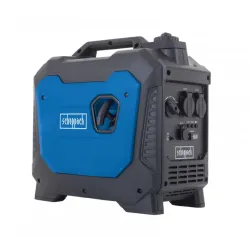
| SG2500i | Sensitive electronics | Inverter type (1.6 / 2.0 kW) — for computers, control units, chargers |
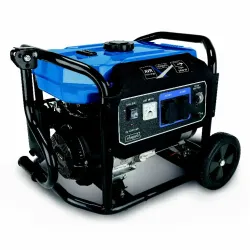
| SG3200x | General home and garden use | 2.5 / 2.8 kW — a universal option for everyday appliances |
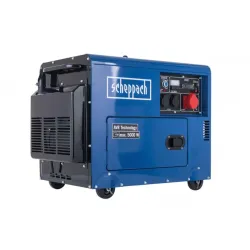
| SG5200D | Longer, more regular running | Diesel model; 230 V: 3.0 / 3.3 kW, 400 V: 4.2 / 5.0 kW |
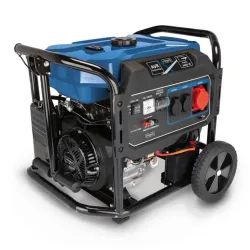
| SG7100x | Three-phase (400 V) load | 400 V: 5.0 kW rated; 230 V output: 2.0 kW |
More comparisons: inverter generator and 230 V or 400 V generator. For the full selection logic see the main guide how to choose a generator.
Safety checklist
- Generator outdoors, away from windows, doors and vents.
- Oil checked, fuel correct, refuelling only on a cold engine.
- Start and stop per the manufacturer’s manual.
- Load below rated power; appliances switched on one at a time.
- Outdoor-rated extension cords, no accidental chains.
- No DIY connection to the house wiring.
- Dry location, safe zone for children and pets.
Frequently asked questions
Can I run a generator in a garage with the door open?
No. CO can build up even with the door open. Run the generator outdoors, away from building openings.
Can I connect a generator to the house with a homemade cable?
No. It is dangerous and can cause backfeed. House wiring needs suitable equipment and an electrician’s work.
How often should I test a backup generator?
Periodically, following the manufacturer’s advice. What matters is that it starts and runs on a light load before you really need it.
Can I refuel a running generator?
No. Stop it and let the engine cool down before refuelling.
Will any extension cord do?
Outdoors you need one designed for it, with sufficient cross-section and undamaged insulation. Avoid accidental chains.
Need help choosing?
If you are unsure which generator suits your appliances and how you will use it, browse the INVENTĀRS Generators range and ask us — we will help compare models against your list of appliances.
Reviews
Be the first to review this article.
Write a review