
230 V or 400 V generator?
Many buyers think 400 V is “more powerful and therefore better”. But it is not a question of power; it is a question of voltage and number of phases. If you have no three-phase load, a 400 V output can be an unnecessary complication — and sometimes a misleading number on the box.
The main guide: how to choose a generator. Here — one question: 230 V or 400 V. Range: Generators, brand Scheppach. Check prices and availability on the card.
230 V and 400 V in plain terms
230 V (single phase). This is the same voltage as in ordinary home sockets. Most appliances run on it: lighting, fridge, kettle, chargers, many tools and pumps.
400 V (three phase). This is needed for three-phase motors and equipment — some pumps, compressors, workshop machines, larger power tools. Appliances with a three-phase plug or connection state it on the label.
When 230 V is enough
- Your appliances have an ordinary plug.
- You need a home backup kit or small tools.
- You have no intention of connecting three-phase equipment.
Then choose by power on 230 V. Example: SG3200x — 2.5 / 2.8 kW, 230 V.
When 400 V is needed
- A three-phase motor or equipment with a 400 V connection.
- A site or workshop with several powerful appliances.
- You need to share the load across phases.
Before choosing, check your appliance label. If it has no three-phase markings, 400 V is most likely not needed.
How to find out what connection you need
- Look at the appliance plug. An ordinary “Schuko” plug is 230 V. A three-phase plug has more pins and is larger.
- Open the label: it usually states 230 V or 400 V (sometimes “3N~”).
- If the appliance is already installed and you do not know the connection, ask an electrician to look at the distribution board.
- If the appliance runs on 230 V and no three-phase output is needed, choosing a 400 V generator is often an unnecessary complication.
Do not try to “adapt” a three-phase appliance to a single-phase connection with improvised solutions. It can damage the appliance and create a dangerous situation — ask an electrician.
The key point: two power figures on one box
On models with both outputs, the power on the 230 V socket is often lower than on 400 V. So do not compare only the biggest number. Examples from the range:
| Model | 230 V (rated / max) | 400 V (rated / max) | Fuel |
|---|---|---|---|
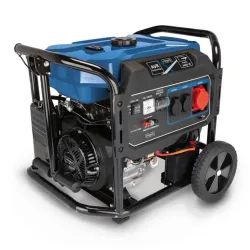
| SG7100x | 2.0 / 2.2 kW | 5.0 / 5.5 kW | Petrol |
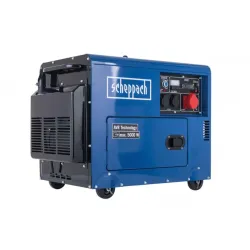
| SG5200D | 3.0 / 3.3 kW | 4.2 / 5.0 kW | Diesel |
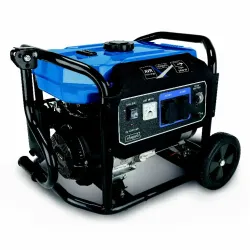
| SG3200x | 2.5 / 2.8 kW | — | Petrol |
As you can see, SG7100x is strong on 400 V but gives considerably less on the 230 V socket. If you mainly need 230 V and about 3 kW, SG3200x or the diesel SG5200D can be a more sensible choice than a model with the “biggest number” on the box. The alternative SKU SG5200D may be out of stock — check the card.
Can both outputs be used at once
Some models have limits on how power is shared between the 230 V and 400 V outputs. Always read the manual: rated power on 400 V does not mean you can get the same on 230 V at the same time. If you plan to use both outputs, ask our consultant or check the manufacturer’s manual.
Everyday examples
A workshop with a three-phase machine. Look at the machine label and compare with the generator’s 400 V power. Remember that a motor’s start-up peak can be much higher than its running power — how to calculate it.
A home and garden with single-phase appliances. 400 V is not needed. A 230 V model such as SG3200x is enough.
A few three-phase and several single-phase appliances. Then it matters to read both power figures and make sure the single-phase output does not end up too narrow. This is a case where it is worth consulting before you buy.
Petrol or diesel with 400 V
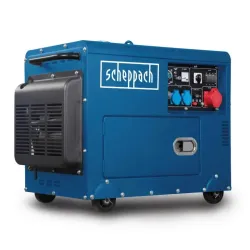
If you need 400 V: petrol is SG7100x, diesel — SG5200D. The article petrol or diesel generator helps you decide.
SG7100x and SG5200D: what they give in practice
SG7100x is a petrol three-phase model: considerable power on 400 V (5.0 kW rated), but on the 230 V output the rated power is 2.0 kW. That makes sense if the main load is three-phase. SG5200D is a diesel model with 3.0 kW on 230 V and 4.2 kW on 400 V — more balanced if the 230 V output must also work seriously, and meant for longer work. Check both cards: data can differ by version.
Connection to a home
If you are thinking about connecting a generator to the home grid, that is a job for an electrician with suitable transfer equipment — not a DIY task. It is even more important in a three-phase system. More: generator for home.
When to simply choose the simpler option
If all appliances in your home and workshop have ordinary plugs and you have no three-phase equipment planned, it is simpler and cheaper to choose a 230 V model. An extra output you will not use brings no benefit — only extra cost, weight and more complex use. If a three-phase load appears in the future, it can be solved at that point with a specific model, not “just in case” today.
Safety reminders
- Run the generator only outdoors with good ventilation — exhaust contains carbon monoxide.
- Connecting three-phase equipment, especially to a home grid, is done by a qualified electrician.
- Do not use damaged cables and plugs.
- Follow the generator manual on earthing and protection.
Common mistakes
- Buying 400 V “for the future” without knowing whether a three-phase load will ever exist.
- Looking only at the biggest power figure, ignoring the 230 V value.
- Assuming a three-phase generator delivers full power on both outputs at once.
- Connecting a three-phase appliance without a suitable plug or a qualified electrician.
Power calculation: how to calculate generator power.
FAQ
Do I need 400 V for a home?
If you have no three-phase appliances, usually not. Check appliance labels.
Does the SG7100x give 5 kW on a 230 V socket?
No. Per the manufacturer’s information the rated power of the 230 V output is 2.0 kW; 5.0 kW applies to 400 V. See your card.
Can I run three-phase and single-phase appliances at the same time?
Depending on the model and the load distribution. Check the manual or consult us.
Which to choose if I need 400 V for long work?
For longer work people usually look at a diesel model such as the SG5200D. Check your load from the labels.
Reviews
Be the first to review this article.
Write a review