
How to choose a generator?

A typical buyer says: “I need a generator, but I don’t know which one.” That is normal — the box has kW, kVA, 230 V, 400 V, petrol, diesel, inverter, and every number makes you think it is the most important one. In reality the key question is different: what do you want to keep running when the power is out.
This guide is the first step. It helps narrow the choice, and for every deeper question it points to a separate article. Model examples come from the Generators range, where the brand is Scheppach. We do not list prices here — they change, so check the current price and availability on the product card.
Start with a list of appliances, not the catalogue
Take a sheet of paper and write three columns:
- Must run — things that cannot stop: heating boiler controls and pump, fridge/freezer, internet, a few lamps.
- Nice to have — comfort: kettle, microwave, TV, water pump.
- Tools — angle grinder, drill, circular saw, concrete mixer, a pump for field work.
Next to each item write the power from the label (W or kW). If the appliance has a motor or compressor, note that it draws more at start-up than while running. With this list, choosing a generator becomes a simple comparison instead of guessing. How exactly to add it up: how to calculate generator power.
Power: not “the more, the better”
A generator that is too small cannot start motors and trips on overload. One that is too large costs more, weighs more and burns more fuel at light load. Manufacturers state two figures: rated power (what the unit can deliver continuously) and maximum power (briefly). Plan around rated power and treat maximum as a short reserve for start-up.
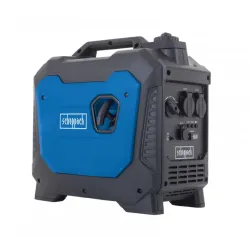
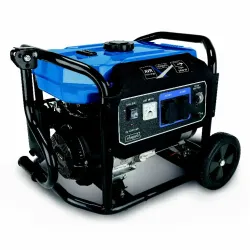
Examples from the range: SG2500i — 1.6 kW rated and 2.0 kW maximum; SG3200x — 2.5 kW rated and 2.8 kW maximum. Check the data on your own card.
Fuel: petrol or diesel
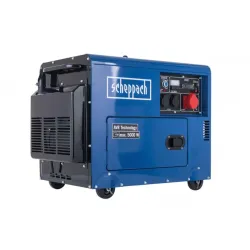
Petrol models are usually lighter and cheaper to buy, and suit occasional use: emergencies, a home, a garden, a small site. A diesel unit is meant for longer and more regular work. The diesel option in the range is SG5200D. For a comparison with examples see petrol or diesel generator.
Voltage: 230 V or 400 V
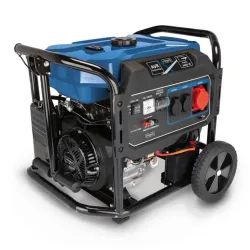
Most household appliances run on 230 V. 400 V (three-phase) is needed for three-phase motors and some equipment. Note: on models with both outputs, the power on the 230 V socket can be much lower than on 400 V. For example, SG7100x per its manual: 230 V — 2.0 kW rated, 400 V — 5.0 kW rated. Details: 230 V or 400 V generator.
Inverter: when you need one
An inverter generator delivers more stable, “cleaner” voltage, which matters for sensitive electronics — computers, boiler controls, chargers. A conventional (AVR) generator often suits motors and tools. When paying extra is worth it and when it is not: inverter generator — when do you need one. In the range: SG2500i.
Scheppach models at a glance
Data from manufacturer information and our cards. Always compare with your own product card before buying.
What a generator does in real life
In a catalogue everything looks simple: enter a number, get a result. In practice a generator works under changing load. The fridge cycles on and off, a pump starts, the kettle suddenly asks for a lot. If a generator runs at its limit all the time, it costs more in fuel, is louder and wears faster.
So a good generator is one that runs with reserve: the load is usually well below rated, and start-up peaks stay close to the maximum. If you must work at the limit every day, take the next power class or spread the load over time.
How to read a product card without getting lost
- Rated power — the main figure for comparison.
- Maximum power — a short-term figure; not for continuous load.
- Voltage — whether the model has 230 V only or also 400 V. If both, read each power figure separately.
- Fuel — petrol or diesel; storage and maintenance depend on it.
- Type — inverter or classic AVR generator.
- Availability — stock status and delivery time change; check the card.
If some data on the card is unclear, ask our consultant before you buy. It is faster than exchanging after delivery.
Noise, location and neighbours
A generator is noisy, although the difference between models is noticeable. The place where you put it matters as much as power. Keep a sufficient distance from windows and bedrooms, think about neighbours, and remember that a generator must never be run indoors. For the actual noise of your model see the manual and the card — it differs by type.
Maintenance and storage people often forget
- Check the oil level before every start — without oil the engine can be damaged.
- Run the generator briefly from time to time to make sure it starts. A standby generator that is never tested may fail when you need it.
- Store in a dry place and follow the fuel guidance in the manual.
- Keep a fuel reserve in a safe, suitable container.
Typical scenarios
A short outage; you need the boiler, fridge and lighting. A smaller unit is usually enough. See generator for home.
Electronics-sensitive load. An inverter model such as SG2500i.
Tools, water pump, small construction jobs. Look at the SG3200x class and check the start-up current.
Three-phase motor or long runs. SG7100x or diesel SG5200D — but first read what each delivers on the 230 V and on the 400 V output.
What to do if you are not sure
If you are unsure, write down three things and send them to us or to an electrician: (1) a list of appliances with label power, (2) whether you have a three-phase load, (3) how often and how long you plan to run the generator. With this information an answer takes minutes, not a week of doubt. And do not be afraid to choose the smallest model if the task is clear — sometimes SG2500i is enough.
Safety: short and important
- Place the generator outdoors, away from windows, doors and vents. Exhaust contains carbon monoxide — dangerous and odourless.
- Refuel only with the engine off and cooled down.
- Never connect a generator to the home wiring yourself (for example with a “double-ended” plug cable). It endangers you and electricians on the grid. Home connection requires an electrician and suitable transfer equipment.
- In case of overload, moisture and rain, follow the manual.
Typical mistakes
- Choosing only by maximum power.
- Forgetting motor start-up current.
- Buying 400 V “for the future” without a three-phase load.
- Expecting one generator to “be enough for the whole house”.
- Not planning fuel, oil and a periodic test run.
When a generator is too large or too small
Too small: the generator trips or “bogs down” when the pump or fridge starts; lamps flicker; automation switches off. The fix is either a larger model or starting devices one at a time.
Too large: more expensive, heavier, and at light load fuel use per unit of energy can be less favourable. If you only need lighting and internet, you do not need a big diesel unit.
Between these extremes is the “right” generator: load comfortably below rated, and only rarely approaching the maximum.
Before you buy — a short list
- Make the appliance list and add up the power (how to do it).
- Decide petrol or diesel, and 230 V or 400 V.
- For sensitive electronics consider an inverter.
- Check rated power, voltage and availability on the product card.
- Think about where it will stand outdoors.
Full range: Generators. Brand: Scheppach.
FAQ
Is a generator equal to the sum of my appliances enough?
Leave a reserve, especially for motors and compressors. See the power calculation.
Can I run a generator indoors?
No. Only outdoors with good ventilation — exhaust gases are dangerous.
Can I connect a generator directly to the house grid?
Not by yourself. You need an electrician and transfer equipment. See generator for home.
How long can a generator run without stopping?
It depends on the model and load; follow the manual and keep a fuel reserve. For longer, regular work people usually look at a diesel solution.
Reviews
Be the first to review this article.
Write a review