
Inverter generator — when do you need one?
If you are buying a generator to keep home electronics running — a computer, router, boiler controls, chargers — sooner or later you will run into the word “inverter”. For some it is a must, for others an unnecessary extra. This article helps you see which one you are.
The basic logic: how to choose a generator. Range: Generators, brand Scheppach.
What is different about an inverter generator
In a conventional (AVR) generator the engine turns the alternator at a speed that sets the AC frequency. In an inverter generator the current is converted electronically, so the output voltage is usually more stable and closer to the grid. The engine can change speed depending on load, which often means lower fuel use at light load and calmer operation. For the noise and consumption of your specific model check the manual.
When an inverter is really needed
- Sensitive electronics — computers, TVs, phone and laptop chargers, routers.
- Boiler and pump controls — if the manufacturer requires stable supply. Check the boiler manual.
- Small and medium loads — when you use the generator only for electronics and lighting.
- Travel, small events, camping — where lower weight and quieter operation matter.
When a conventional generator is enough
- For tools — grinders, drills, circular saws — where power matters more than “clean” voltage.
- For water pumps and other motors, if the manual sets no special requirements.
- If the budget is limited and electronics are not connected or are protected separately.
Stay honest about the task: if you need power for tools, the SG3200x class can be more sensible than an inverter. If you need to run electronics — think inverter.
Why stable voltage matters for electronics
Modern devices have power supplies and control boards that are more sensitive to voltage fluctuation than older motors or incandescent lamps. A conventional AVR generator usually gives enough stability for motors and tools, but for sensitive electronics manufacturers often recommend an inverter-type source. If the appliance maker states power-supply requirements, follow them; if not, an inverter is the calmer choice.
Fuel consumption and operating mode
Many inverter models have a mode that adapts engine speed to the load. At light load the engine can run calmer and more economically. How much exactly depends on the model, so do not trust tables online; read the manual and compare with your load. Remember also that during short peaks (for example fridge start-up) the revs increase.
Compact is convenient, but power is limited
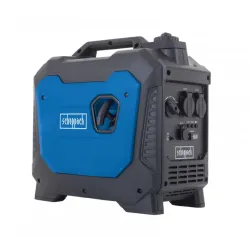
Inverter models are usually more compact and lighter. The trade-off is a power limit. For example SG2500i gives 1.6 kW rated and 2.0 kW maximum. It suits electronics, lighting and small loads, but is not meant for running large motors or several powerful appliances at once. Add up the power before choosing: how to do it.
Larger inverter models
Inverter and emergencies at home
If you plan a small backup kit — boiler, controls, internet, lighting, fridge — an inverter is often convenient. But remember: starting the fridge compressor needs reserve. How to plan a backup kit: generator for home.
Typical scenarios
Boiler, internet, light in winter. A typical task for a small inverter. Check the boiler and pump power and leave reserve for start-up. SG2500i fits this task if the load sum does not exceed the rated power.
Camping, holiday house, small event. Lighting, sound, chargers — the inverter class is convenient because it is more compact.
Work with power tools on site. Here it is better to look at power and durability — the SG3200x class or larger.
Home workshop with a larger load. If there is three-phase equipment, the inverter class will be too narrow; see 230 V or 400 V.
Maintenance and storage
An inverter, like a conventional generator, needs its oil level checked before starting, fuel quality watched and the unit test-run periodically. Inverter electronics dislike moisture and dust — store in a dry place and do not leave it in the rain. Detailed intervals and requirements are in the manual.
Comparison at a glance
What an inverter does not change
An inverter does not make a generator a source of unlimited power. If the sum exceeds the rated power, an inverter model is overloaded too. It also does not cancel safety rules: outdoors, away from windows, refuel only with the engine off, and home connection only with an electrician and transfer equipment. These things are the same for all generators.
Decide with three questions
- Will sensitive electronics or boiler controls be on the generator? If yes — start with an inverter.
- Is the power up to a few kW? If yes, the inverter class is often enough; if many motors must run — look at a conventional generator.
- Are weight, portability and quietness important? If yes, an inverter is usually more convenient, but check your exact model.
If the answer to all three is “no”, a classic model is most likely enough, and you can spend the money on reserve fuel or extra cables.
What to check on the card
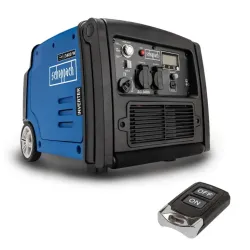
Compare rated and maximum power, voltage (for inverter models usually 230 V), fuel type, and whether the model is in stock. If the card lists extra outputs or a remote control, check how they work day to day. Different versions may have different specifications — do not rely on descriptions from previous years.
Common mistakes
- Thinking an inverter is always quieter than everything else — noise depends on model and load.
- Buying an inverter and expecting it to run a heavy tool or several motors.
- Ignoring appliance start-up peaks.
- Choosing only by rated power, ignoring voltage and fuel.
FAQ
Does a heating boiler need an inverter?
It depends on the boiler controls. Check the boiler manual and consult the service company. For many boilers stable voltage is safer.
Is an inverter generator quieter?
Often yes, but not always. See the model manual and operating conditions.
Can I run a fridge on an inverter?
If power and start-up peak are sufficient, yes. Check the fridge label and the generator card data.
What to choose if I need both electronics and tools?
Weigh the main task. If tools dominate, focus on power; if electronics, on the inverter. If both matter, contact us.
Reviews
Be the first to review this article.
Write a review