
How to calculate generator power?

“How many kilowatts do I need?” — the question we hear most often. The answer is not one universal number. You can calculate it in a few steps if you know what you will connect to the generator and how those appliances behave at start-up.
This article supplements the main guide how to choose a generator. We do not promise specific appliance wattages here: they depend on model, age and mode. Always check the label on the appliance or its manual.
Step 1 — make a list
Write down everything you want to run at the same time. Important: at the same time, not “sometime”. If the kettle and the microwave never run together, they do not need to be added together.
Split the list into two groups:
- Appliances without a motor — lamps, chargers, TV, kettle, heater. Their start-up peak is usually not large.
- Appliances with a motor or compressor — fridge, pump, drill, grinder, saw. At start-up they can draw much more than while running.
Step 2 — find the power on the label
Look for W or kW on the appliance plate or in the manual, sometimes current in amperes (A). If only current is shown, you get approximate power by multiplying by voltage: 230 V × current (A) ≈ W. This is an indicative calculation; see the manufacturer’s information for precision.
| Appliance group | What to check | Note |
|---|---|---|
| Lighting, chargers, electronics | W on the adapter or label | Usually small loads; add them up |
| Heaters, kettle, grill | W on the label | Often the biggest consumers — no distinct start-up peak, but a high constant load |
| Fridge, freezer | W or A on the label | The compressor starts with a peak; allow reserve |
| Water or sewage pump | W on the pump label | Start-up current can be several times higher |
| Tools (grinder, drill, saw) | W on the housing | Consumption rises under load; calculate by the maximum |
Step 3 — add up the simultaneous load
Add the W of all appliances that will run at the same time. An example for illustration (the numbers are made up and are not data of specific appliances): if your labels say 150 W, 80 W, 600 W and 1000 W, the running load is 1830 W. This is just an arithmetic sample — your numbers will differ.
Step 4 — add motor start-up
For motors and compressors the start-up current can be several times the running current — sometimes called the start-up peak. If the appliance states it, use the stated value. If not, take a reserve and do not plan appliances to start at once: start the fridge first, then the pump.
A practical rule: the generator must not lose speed and “bog down” at start. If it does, power is too low or appliances are starting together.
Step 5 — reserve
Do not plan continuous work at the limit. Leave roughly 20–30% reserve above the calculated running load — it reduces wear and leaves room for peaks. This is a practical suggestion, not a standard; read the generator manual for precision.
Two short examples (illustration, not appliance data)
The numbers below are made up to show the method. Your labels will differ.
| Scenario | What runs at the same time | How to think |
|---|---|---|
| Minimal backup kit | Lighting, internet, boiler controls, fridge | Add the running power, then add a reserve for the fridge start. If the sum is small, a compact inverter model will do. |
| Work with tools | Grinder or saw + lighting | For the tool, take the maximum consumption, not only the “average”. With reserve this may require a mid-power generator. |
Important: if your sum comes out at the limit rather than “a little above”, choose the next power class or switch off some appliances. A generator running at maximum is not a long-term solution.
How to tell that power is too low
- The generator “bogs down” or trips when the pump or fridge starts.
- Lamps suddenly dim or flicker.
- Appliances switch off or restart.
- The generator runs at constantly high revs and gets noticeably hot.
If this happens, switch off some appliances and recalculate. If the problem repeats, you need a larger model.
What if the label has no power rating
On some older appliances the label is worn or shows only current. Use the manual or the manufacturer’s website. If it is not there either, take a cautious reserve based on the type and consult an electrician. Do not trust online tables of “typical” values as final truth — for each appliance they differ.
W and kVA — the same thing?
No. Watts (W) show the real power an appliance consumes. Volt-amperes (VA, kVA) are apparent power, and W is obtained by taking the power factor (cos φ) into account. Some generators state kVA, others kW. Compare in the same units; if you see kVA, multiply by the factor the manufacturer gives. If there is no factor, look for kW on the card.
Rated and maximum power
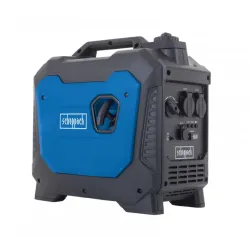
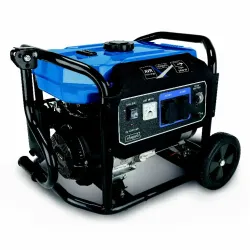
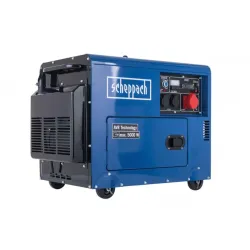
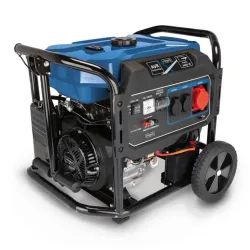
Range examples: SG2500i — 1.6 kW rated and 2.0 kW maximum; SG3200x — 2.5 / 2.8 kW; SG5200D on 230 V — 3.0 / 3.3 kW, on 400 V — 4.2 / 5.0 kW; SG7100x on 230 V — 2.0 / 2.2 kW, on 400 V — 5.0 / 5.5 kW. Compare your calculation with the rated power and at exactly the voltage you will use. Check your card.
Altitude, temperature and other factors
Engine output can fall at higher altitude and in hot conditions, and with wear. In Latvia this is rarely decisive, but a generator running in a hot, enclosed place cannot deliver everything the label says. Leave room for airflow and do not put it in a closed box. For safe placement read generator for home.
Common mistakes
- Adding up every appliance in the house although only a few run at once.
- Forgetting the start-up peak of motors and compressors.
- Comparing with maximum instead of rated power.
- Mixing up W and kVA.
- Ignoring that the 230 V output of a 400 V generator can be lower than the headline figure.
Quick checklist before you press “buy”
- The appliance list with W or kW from labels is written.
- You have marked which appliances start with a peak (motors, compressors, pumps).
- You know what will run simultaneously.
- A reserve has been added (roughly 20–30%, more for motors).
- Compared with the generator’s rated power at the voltage you will use.
- Current price and availability checked on the product card.
Next
Once you know the power, decide on fuel, voltage and whether you need an inverter. Home scenarios: generator for home. Range: Generators, brand Scheppach.
FAQ
Can I calculate power from my electricity bill?
Not precisely. A bill shows energy over time (kWh), while a generator needs simultaneous power (kW). Better to look at appliance labels.
How much reserve is needed?
Practically about 20–30% above the running load, more if there are motors. Follow the manual.
What if I am not sure?
Write the appliance list with label data and consult us or an electrician. Check prices and availability on the card.
Reviews
Be the first to review this article.
Write a review