
How to use a chainsaw safely?

The chainsaw is bought, the box is open, and the pile of firewood or the fallen branches are already waiting. This is exactly the moment when many people make the biggest mistake: they start cutting straight away, without checks and without protection. The first cuts after a purchase are not a test of the saw but a test of your habits. This article gives a calm, practical minimum to start with — before the chain touches wood for the first time.
It does not replace the manual or training. It helps you understand what to do before work, during work and after it. If you are still choosing a tool, start with how to choose a chainsaw; sharpening and tensioning the chain are covered separately in how to maintain a chainsaw chain.
Start with the manual, not the start-up
Every model has its own starting method, its own safety devices and its own limits. So read the manufacturer’s manual to the end — even if you have already tried cutting. This applies to all types and brands, including Scheppach, DCK and Worx: there is no universal “correct” set of steps that can be carried over from one saw to another.
If you plan not only to cut branches but also to fell trees, practical training is recommended. Felling is a different level of work from cutting up logs on the ground — a mistake there can be very costly. Simple jobs on the ground are a good start; learn the rest from someone who does it properly.
Protective equipment — before any start
A chainsaw has no “harmless” modes. Even for a short job, put on the full set:
- Eyes and face — safety glasses or a face screen; chips and branches snap back unexpectedly.
- Ears — hearing protection, because noise tires you and damages hearing even with quieter models.
- Hands — gloves with a good grip.
- Legs — cut-protection trousers (with a cut-resistant layer).
- Footwear — sturdy boots with a non-slip sole, preferably with cut protection.
Overview and selection — in the article how to choose protective equipment. If the protection is not ready yet, the saw can wait.
Check before every use
It takes a couple of minutes but prevents most unpleasant surprises:
| What to check | Why |
|---|---|
| Chain tension | A chain that is too loose can slip off; one that is too tight overloads the bar and motor. If it needs adjusting, act according to the manual — more detail in the chain care article. |
| Chain oil | The chain and bar must be lubricated while working; check the tank level. |
| Chain brake | It is a safety device — check that it works as described in your manual. |
| Bar and chain | No cracks, deformation or broken teeth; remove the bar guard only when it is needed. |
| Handles and housing | Everything firmly fastened, with no loose or damaged parts. |
Starting: only by your own manual
Petrol, corded and battery models start differently, and even saws of the same type can have different steps. That is why there are no universal tips here about lever positions or quick-start tricks — only the manufacturer defines them. The common principles are these:
- Place the saw on a stable, level surface rather than holding it in the air.
- Make sure the chain is not touching anything — not the ground, not a log, not clothing.
- The chain brake is engaged at start-up if the manual provides for it.
- People, children and animals are at a safe distance.
- Follow the starting method and sequence strictly according to your model’s manual.
Stance and grip
A stable stance is as important as a sharp chain. Stand with your feet shoulder-width apart, with your weight evenly distributed, and do not stand in line with the chain. Always hold the saw with both hands: all fingers wrapped around the handle, but the thumb under the handle, not on top of it. If the grip is weak, the kickback force quickly pulls the saw out of your hands.
Cut no higher than shoulder height. Higher up the saw becomes hard to control, and falling parts land right on you. If a branch is higher, choose another solution or leave the job to a specialist.
Kickback and the tip of the bar
Kickback is a sudden movement of the saw upwards and back towards you when the chain catches or pinches in the wood with the tip of the bar. It happens very fast — faster than a person can react. That is why it matters to know in advance where the risk is:
- Do not touch wood, branches or the ground with the upper tip of the bar unless the manual allows it.
- Start the cut with the chain at full speed and carefully, rather than forcing the saw into the wood.
- Do not push or force — let the saw do the work.
- Look at where the saw can get pinched: branches under tension and logs that close in on the cut are risk situations.
These are general rules. Look for specific warnings about your model in the manual.
Never from a ladder and never in a tree without training
One of the most dangerous ways to get a serious injury is to cut while standing on a ladder or climbing a tree. The saw is heavy and the chain fast, but in the event of kickback there is neither support nor room to step back. Do garden and firewood jobs from the ground, in a stable position. Leave work at height and in trees to a trained arborist. Read more about garden tasks in the article chainsaw for the garden, and about preparing firewood in chainsaw for firewood.
Fuel and battery
Petrol models: refuel when the engine is cold and away from open flame or sources of sparks. The fuel type and mixture are defined by the manual; if you have spilled some, wipe it off and wait until the vapours disperse before starting.
Battery models: before work check the charge and that the battery is firmly seated. When you stop work, remove the battery before any maintenance. For corded models check the cord insulation and keep the cord behind you, not under the bar.
After work: stop, brake, cool, store
- Switch the saw off and wait until the chain stops completely.
- Engage the chain brake if the manual provides for it.
- Let the saw cool — especially a petrol one.
- Clean the sawdust from the bar groove and the oil hole.
- Put the bar guard on and store the saw in a dry, safe place — out of reach of children.
- Store the battery as the manufacturer indicates; coil the cord without sharp kinks.
Which saw to choose for your first jobs
A safe start is a tool that matches the job — not too heavy, not too powerful. Examples from the Chainsaws category (check prices and availability on the product card):
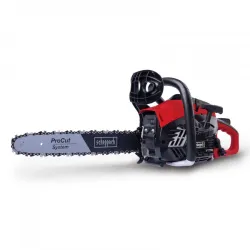
- Scheppach PCS38 — a petrol model of the mid-range class; suitable for home and rural work where there is no socket.
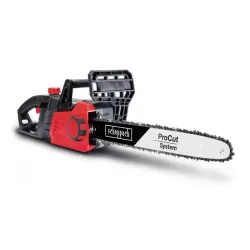
- Scheppach CSE2700 — a corded electric model for the yard if a socket or extension lead is nearby.
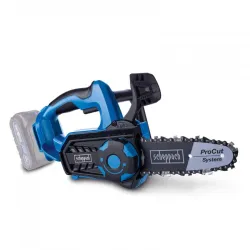
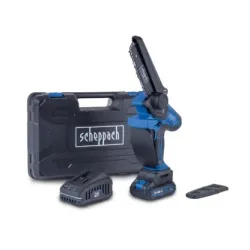
- Scheppach BC-TCS200-X and Scheppach BC-PS150-X — lighter battery options for branches and garden care.
Check what is included, the specification and the stock status on the card — especially for battery models, as some are supplied without a battery. The article petrol, electric or battery chainsaw helps you choose between types.
Typical mistakes in the first cutting sessions
- Starting work without cut-protection trousers and ear protection “just for a moment”.
- Not checking the chain brake and oil before work.
- Cutting with one hand or in an unstable position.
- Working above shoulder height or from a ladder.
- Starting the saw “from memory” or by the habit of another model, without checking the manual.
- Working while tired; fatigue is one of the safety risks.
A short checklist before the first cut
- Manual read, training planned if tree felling is intended.
- Full protective set on.
- Chain, oil, brake and bar checked.
- Saw started only by the manufacturer’s steps.
- Stance stable, both hands on the saw, cut below shoulder height.
- Work done on the ground; at height — a specialist.
Frequently asked questions
Is training mandatory before the first time you cut?
For cutting branches and logs on the ground, the manual and attention are enough, but for felling trees training is strongly recommended.
Do these rules also apply to a battery saw?
Yes. The chain and kickback are just as dangerous; with battery models you also need to check the charge and remove the battery before maintenance.
Should branches be cut while standing on a ladder?
No. A chainsaw is not intended for work on a ladder or in a tree without training.
Reviews
Be the first to review this article.
Write a review