
How to maintain a chainsaw chain?

A saw that cut smoothly yesterday pulls to one side today, smokes and needs pushing. Buyers often think “the motor is worn out”, but the cause is most often much simpler — the chain is dull, too loose or too tight, or there is no oil. This article brings together everything you need to know about chain upkeep: how to recognise a problem, how to check tension, how to think about sharpening and when to replace the chain.
Important: exact values (tension, sharpening angles, file diameter, chain type) depend on the specific model. So this is a general guide, and the deciding word always belongs to the manufacturer’s manual. If you are still choosing a saw, start with how to choose a chainsaw.
How to recognise a dull chain
- The saw produces fine dust instead of chips.
- You have to push the saw hard to make it go into the wood.
- The saw pulls to one side or the cut is crooked.
- The wood starts to smoke or turn brown at the cut.
- Work gets slower, but the motor runs just as loud.
If even two of these signs are present, the chain should be checked. Working with a dull chain tires you, needlessly loads the saw and makes you push — which is also a safety risk.
Before any maintenance — safety
- Switch the saw off. For a petrol model make sure the engine is not running; for an electric one unplug the cord from the socket; for a battery model remove the battery.
- Put on protective gloves. The chain teeth are sharp even when the saw is off.
- Let the saw cool down if it has been working.
- Place the saw securely — on a bench or clamped down.
- Act according to the manual. For protective equipment see the article protective equipment.
Chain tensioning
A chain that is too loose can come off or run incorrectly along the bar, and one that is too tight overloads the bar, the chain drive and the motor. How to check:
- Make sure the saw is off and the chain has cooled.
- With gloves on, check that the chain moves easily along the bar.
- Check that the chain’s drive links do not disappear into the bar groove and that the chain does not sag below the bar.
- If it needs tensioning, loosen the bar fastening and use the tensioning mechanism exactly as in your manual, then tighten everything firmly again.
The manufacturer states how much chain slack is permissible, so do not tension “by feel”. A new chain often needs its tension checked after the first minutes of use — check that in the manual too.
Sharpening: what you need to know
A chain can be sharpened yourself or left to a service centre. In both cases it is important that sharpening is even and matches the chain type. Incorrect sharpening can make the saw more dangerous and the chain unusable.
- File size and angles depend on the chain pitch and the manufacturer’s instructions. They are not the same for everyone — see your chain’s marking and the manual.
- All teeth must be sharpened equally; a different length or angle produces a crooked cut.
- In addition to sharpening the teeth, keep an eye on the depth gauges (rakers). If you do not know how to do this, leave it to a service centre.
- If the chain is damaged, cracked or heavily worn, sharpening will not save it.
If you do not feel confident, it is better to choose a service centre than to experiment. A safe chain is more important than saved time.
Oil: without it the chain wears out fast
The chainsaw chain and bar must be lubricated while running. Before work check the oil tank level, and during work check from time to time that oil is reaching the bar. Use the oil recommended by the manufacturer. This applies to petrol, electric and battery models alike — check in the manual how it works on your saw.
When the chain needs replacing
| Sign | What to do |
|---|---|
| Teeth heavily worn or broken off | Replace the chain |
| Chain links damaged, cracked | Replace the chain |
| The chain can no longer be tensioned or is stretched | Check the chain and bar, replace if necessary |
| The saw still cuts badly after sharpening | Have the chain and bar checked at a service centre |
The new chain must match the type, pitch and number of links stated in the saw’s manual. Do not use another chain “because it is similar”.
How to look after the chain between uses
- After work clean the sawdust from the bar groove and the oil hole.
- Check the condition of the chain — look for cracks, broken teeth or excessive wear.
- Do not let the chain touch the ground, stones and nails — that is the main reason teeth get dull quickly.
- Store the saw with the bar guard on, if one is included.
- If the chain has been standing for a long time, check lubrication and tension before the next job.
The bar is as important as the chain
A dull chain damages the bar too, and a damaged bar damages the chain. From time to time look at the bar groove and edges: if they are unevenly worn or deformed, the chain may not run correctly. Coordinate replacing the bar and chain with the manual — they must match each other in pitch and groove width. Not sure what to buy? Ask a consultant, stating your saw model.
Scenarios: what to do in a specific situation
The saw starts to smoke at the cut. Stop work, check the oil level and the sharpness of the chain. If the chain is dull, sharpen it or take it to a service centre.
The chain suddenly becomes loose. Switch the saw off and check tension as per the manual. If it repeats, check the chain and bar.
The saw pulls to one side. The most common cause is unevenly sharpened teeth. The best solution is proper sharpening or a service centre.
The chain has hit the ground or a stone. Check for broken teeth; if in doubt, replace the chain.
Examples: where to look for data
For all three models below, chain data can be found in the manufacturer’s manual and on the product card:
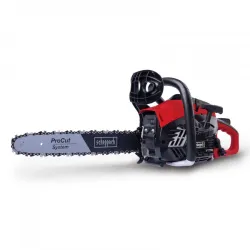
- Scheppach PCS38 — petrol model with a 35 cm bar.
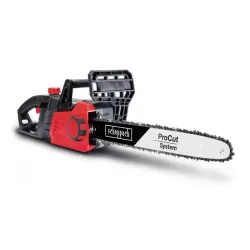
- Scheppach CSE2700 — electric model. Unplug the cord before maintenance.
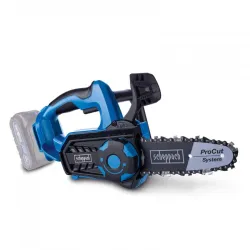
- Scheppach BC-TCS200-X — battery model. Remove the battery before maintenance.
Check availability and what is included on the card. We do not list prices.
Typical mistakes
- Working with a dull chain “just a little longer”.
- Tensioning the chain while the saw is hot or connected.
- Sharpening at the wrong angle or using the wrong file.
- Forgetting about oil or using an unsuitable one.
- Working without gloves while servicing the chain.
- Not checking the chain brake before work.
What to take along for the job
A small kit worth keeping by the saw is practical for chain care: the chain oil recommended by the manufacturer, gloves, a wrench or tool for the bar fastening (usually included), a cleaning brush for sawdust and a spare chain that matches the manual. A spare chain lets you keep working while the dull one is sharpened or taken to a service centre. Choose other auxiliary tools and exact sizes only according to your saw’s documentation.
A short checklist before work
- The chain is sharp and has no visible damage.
- Tension matches the manual.
- The oil level is sufficient.
- The chain brake works.
- Protective equipment is on.
- You hold the saw with both hands and know about kickback.
Frequently asked questions
How often should the chain be sharpened?
It depends on the wood and usage. Sharpen when signs of a dull chain appear, not by the calendar.
Can the chain be sharpened at home?
Yes, if you know what you are doing and follow the manual. If in doubt, choose a service centre.
Do these tips also apply to battery and electric saws?
The principles are similar, but always follow your own device’s manual. For a comparison between types see the article petrol, electric or battery.
Reviews
Be the first to review this article.
Write a review