
Petrol, electric or battery chainsaw?

When a buyer asks which chainsaw is the best, the best answer is a question back: where will you work and for how long? In the yard by the house, where there is a socket, one tool gives one experience; in the forest or at a remote plot — quite another. This article helps you understand when petrol makes sense, when a corded saw does, and when a battery does.
Examples are from the Chainsaws category — Scheppach, DCK, Worx and HiKOKI. We do not list prices; check the current price and availability on the product card. If you have not yet decided on the general direction, first read how to choose a chainsaw.
Comparison in one table
| Criterion | Petrol | Electric (corded) | Battery |
|---|---|---|---|
| Where you can work | Anywhere you can bring fuel | Where a socket or extension lead reaches | Anywhere, as long as the battery lasts |
| Starting | Takes practice and starting as per the manual | Press the switch and work | Press the switch and work |
| Noise | Loud | Quieter | Usually the quietest |
| Maintenance | Fuel, oil, filters, spark plug | Chain, oil, cord | Chain, oil, battery care |
| Long, intensive work | Usually the most suitable | Good if you have mains power | Depends on the number of batteries |
| Occasional use | May be too complicated | Convenient | Very convenient |
This table is a general guide; specific data for each model is on the product card and in the manufacturer’s manual.
When to choose a petrol chainsaw
A petrol model makes sense if you work far from mains power, if there is a lot of firewood, or if you cut regularly and for longer. It also demands discipline: the right fuel as per the manual, chain oil, a clean filter, storage after the season.
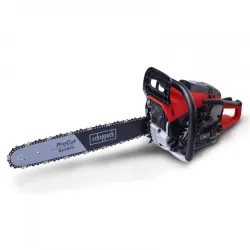
The range here is wide. An example of the mid-range class is Scheppach PCS46 with a 45 cm bar and 1.8 kW. It is a solution for those who prepare firewood fairly often and do not want to depend on a socket. More about firewood in the article chainsaw for firewood.
When to choose a corded electric saw
If the work site is near the house, shed or workshop, a corded model is convenient and simple: no fuel, no pull-cord starting. It suits preparing firewood in the yard, trimming near buildings and lighter farm jobs.
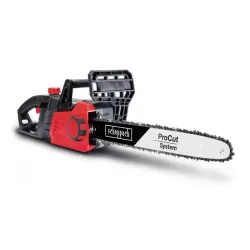
An example is Scheppach CSE2700 with 2700 W. Practical points: the extension lead must be suitable for outdoor use, the cord must stay behind you and away from the bar, and you must not work in the rain. A corded saw has one major drawback — the distance to the socket. Check availability on the card.
When to choose a battery chainsaw
Battery models suit garden work, trimming branches and small repairs — short jobs without much preparation. They are quieter and easier to use, but run time is determined by battery capacity.
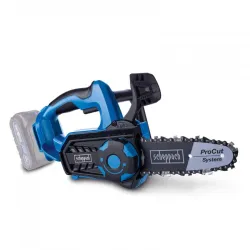
- Scheppach BC-TCS200-X — 20 cm bar, supplied without a battery. Worth it if you already have compatible batteries and a charger.
- DCK 30 cm — 20 V kit with a 30 cm bar, suitable for everyday garden work.
- HiKOKI CS1825DC — a HiKOKI model for those who already use this manufacturer’s battery tools. Check bar and battery data on the card.
Important: before buying, find out whether a battery and charger are included. If not, they have to be added separately.
Where Worx fits
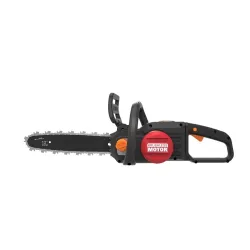
The Worx range includes home and garden saws, for example Worx WG350E. They are intended for yard tasks, not professional forestry. Check the power source and bar data on the product card rather than assuming from the name.
Scenarios: what suits whom
A private house, a couple of trees, branches to trim once a season. A battery model is enough and convenient. See saws for the garden.
Firewood every year, the house has outbuildings and a socket. A corded electric model can be perfectly adequate if the work happens in the yard.
Firewood in large volumes or far from mains power. The petrol class, for example PCS46.
You need a saw after a storm or an emergency. Independence from the grid matters here — petrol or an additional battery kit.
Noise, smell and neighbours
A petrol saw is loud and its exhaust fumes are noticeable. If you work in a village or a more densely populated place, it can become an issue between neighbours. Corded and battery models are quieter, so early in the morning or in the evening they are a calmer solution. Still, they also make mechanical noise, so ear protection is necessary in all cases. Look for specific noise-level information in the manual.
Storage after the season
A petrol saw must be prepared for storage after the season according to the manual — especially regarding fuel. A corded saw should be stored in a dry place with the cord insulation undamaged. Store the battery of a battery saw as the manufacturer indicates: not in a place that is too hot or damp. It is a small difference between types, but a significant one over time.
Hidden costs and trade-offs
- For petrol: fuel, oil, maintenance, winter storage.
- For a corded saw: a quality extension lead and somewhere to keep it.
- For battery: a spare battery if the work lasts longer than one charge.
- For all types: chain oil, sharpening, protective equipment.
Safety is the same for all types
Regardless of type, kickback and chain movement are equally dangerous. Use protective equipment: a helmet with face and ear protection, gloves and cut-protection trousers. Hold the saw with both hands, check the chain brake before work and follow the manufacturer’s manual. For battery and electric models, disconnect the power before servicing the chain. About the chain — how to maintain a chainsaw chain.
If in doubt: compromise options
For some owners one type is not enough. For example, if you have a large property but sometimes need to cut in a far corner, in practice two tools can make sense: a corded or battery model for everyday use and a petrol saw for rare, larger jobs. This is not mandatory, but it is often more sensible than one universal “compromise” model that is not convenient in any situation.
The second compromise path is to choose a battery system whose batteries also fit other garden tools. Then the cost is spread across several tools. Since compatibility depends on the manufacturer, check it on each model’s card.
How to decide in five minutes
- Is there a socket at the work site? If yes — consider a corded or battery model.
- Is the work long and regular? If yes — consider petrol.
- Are quiet and simplicity the priority? Then battery.
- Do you already have batteries for some system? Check compatibility with models of the same brand.
- On the product card, check bar length, what is included and availability.
Frequently asked questions
Can a battery saw replace a petrol one?
For some tasks — yes, especially in the garden. For heavy, prolonged work a petrol model is often more practical.
Is a corded saw safer?
The chain is equally dangerous. The cord adds a risk, so keep the cord at a safe distance and work in dry conditions.
Is it worth buying a saw without a battery?
Yes, if you already have compatible batteries and a charger. Otherwise take the kit.
Full range: Chainsaws.


Reviews
Be the first to review this article.
Write a review