
Which chainsaw to choose for firewood?

Firewood in autumn looks like a small task — until there are several cubic metres in the pile and your arms are already tired. Then it becomes clear that a chainsaw should be chosen not as “whatever there is”, but according to how much firewood you prepare and what size the wood is.
This article shows how to decide between occasional and regular use, between petrol, corded and battery, and how not to fall into the bar-length trap. Examples are from the Chainsaws range. We do not list prices — check the current price and availability on the product card.
How often and how much?
| Situation | What to consider | Note |
|---|---|---|
| Occasional firewood, a few cubic metres, close to the house | Electric or a mid-range petrol saw | Check whether the socket reaches the cutting spot |
| Regular firewood every season | Petrol chainsaw with a 45 cm or longer bar | Endurance for longer work matters |
| Thick trunks, larger volumes | More powerful petrol model | See the manufacturer’s recommended cutting diameter |
| Branches and thinner logs | Lighter model where a big bar is not needed | Less tiring for the arms |
Diameter and bar: how to understand it
First, remember: the working cut length is shorter than the bar length. If the bar is 45 cm, it is wrong to expect it to cut through a 45 cm thick trunk without problems. Second, thicker wood requires not only a longer bar but also sufficient power and a stable machine.
As a rough guide (not a manufacturer statement): if most of your trees are thinner, a 35–40 cm bar is often enough; if you regularly meet thicker wood, pay attention to the 45–50 cm class. Always check the recommended diameter and power for each specific model in the manual, not by general rules.
Petrol models for firewood
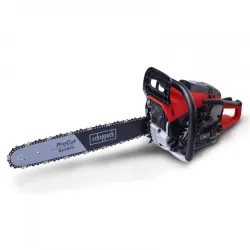
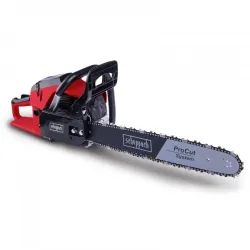
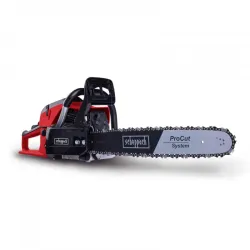
If firewood is prepared in larger volumes or in a place without electricity, a petrol saw is a logical choice. The range has several classes with a similar purpose:
- Scheppach PCS46 — 45 cm bar, 1.8 kW. Mid-range class for home firewood.
- Scheppach PCS53 — 51 cm bar, 2.0 kW. A convenient choice if the trees are thicker.
- Scheppach PCS56 — 50 cm bar, 2.3 kW. A more powerful model for more intensive work.
The differences between them are in bar length and power; check weight, what is included and availability on the product card. The bigger the class, the heavier the work for your arms — especially if you prepare firewood for hours.
An electric saw for the yard pile
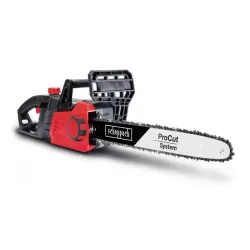
If you cut firewood close to the house and there is electricity at the pile, a corded model can be more convenient: no fuel, no pull cord, no smell. Scheppach CSE2700 with 2700 W is an example for this situation. Remember the extension lead suitable for outdoor work, and the cord — it must be behind you, not under the bar. You can work only in dry conditions.
Battery option: when it suits firewood
Battery models suit firewood in smaller volumes and thinner logs. An example is DCK 45 cm, 58 V. A bar and voltage like that point to a more serious battery class, but the amount you can cover depends on battery capacity and work mode. Check what is included on the card and make sure the batteries will be enough for your job.
Where Worx fits
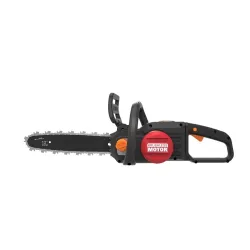
Worx WG350E is an example from the home and garden segment. Its task is not large piles of firewood, but lighter farm jobs. If your volumes are large, look at the 45–51 cm petrol class or another product according to the diameter stated by the manufacturer.
How to organise the work so firewood does not cost you your health
A good plan is often more important than the saw class. Before you start, prepare the place: a clean, level area, a support for logs, enough room to turn. Prepare enough chain oil, fuel or batteries up front so you do not have to interrupt the work halfway.
- Arrange the logs so that they cannot roll.
- Cut in portions — short cycles with rests.
- Do not cut into the ground; the chain gets dull quickly when it touches sand and stones.
- Keep sawdust and branches from getting in the way of your footing.
- Do not let children and animals near the cutting area.
Typical mistakes when preparing firewood
- Buying a bar that is too long, although most trees are thin.
- Working with a dull chain because “I just need to finish”.
- Forgetting about oil and a fuel reserve.
- Overexertion: hours of work without a break.
- Trying to cut wood that is too thick or under tension without experience.
Weight, vibration and fatigue
When talking about firewood the most important factor is often forgotten — how long a person can work safely. Fatigue is one of the safety risks. If the saw is heavier than you can handle, control of the cut drops. It is better to work in smaller portions with breaks than to push through in one go.
What to do if volumes change
Many people start with a small amount of firewood, but over time it grows. If you do not know now whether firewood will be an annual task, choose a mid-range class and stop there, rather than taking the biggest right away. If the work turns out to be larger, you can always add a more powerful saw, and the first tool will remain useful for smaller tasks. Also assess your own health and strength: you do not need a heavy saw just because it is the “right” one.
Safety when preparing firewood
- Use the full set: helmet with face and ear protection, gloves, cut-protection trousers and sturdy footwear. See protective equipment.
- Always hold the saw with both hands.
- Cut with awareness of kickback — do not load the upper tip of the bar.
- Check the chain brake before work.
- Stable support: the log must not roll, and the person cutting must have a stable stance.
- Never work when tired or inattentive.
- Leave difficult situations (trees under tension, fallen trees) to a trained specialist.
Follow everything according to the manufacturer’s manual. About chain upkeep — how to maintain a chainsaw chain; a dull chain makes preparing firewood both slower and more dangerous.
Before you buy — a short checklist
- Roughly estimate how much firewood you will prepare per year.
- Measure the thickness of the trees you meet most often.
- Decide on the type: petrol, corded electric or battery (comparison).
- Choose a bar length with a sensible reserve, not the maximum.
- On the product card, check power, what is included and availability.
- Prepare protective equipment and chain oil.
Frequently asked questions
Is a 50 cm bar necessary for all firewood?
No. If the trees are smaller, a lighter model will be more comfortable. A longer bar is needed if you regularly meet thicker wood.
Can you prepare firewood with a corded saw?
Yes, if the cutting spot is near a socket and the volumes are not huge.
Is one saw enough for firewood and the garden?
A mid-range saw often does both jobs, but for garden work a lighter model is more comfortable. See chainsaw for the garden. For general advice see the article how to choose a chainsaw.

Reviews
Be the first to review this article.
Write a review