
How to choose a chainsaw?
A typical buyer says: “I need a chainsaw, but I don’t know which one.” The catalogue has petrol, electric and battery models, guide bars from a few centimetres to half a metre, power in watts and kilowatts — and every number seems important. In practice one question narrows the choice: what will you cut most often, and for how long at a stretch?
This guide helps you answer it step by step. Model examples come from the Chainsaws range, which includes the brands Scheppach, DCK, Worx and HiKOKI. We do not list prices here because prices and availability change — check the current information on the product card.
Start with the job, not the model
Write down what you plan to do next season. If it is “trim a few branches after a storm”, you need a very different tool than if you have to prepare firewood for the whole winter. The table below helps you orient yourself.
| Job | Type | What matters |
|---|---|---|
| Branches, garden care, rare use | Battery or a small electric saw | Light weight, short bar, easy start |
| Trimming branches from the ground, small trees | Mini / arborist model | Compact size, good handling |
| Firewood a few times a year | Corded electric or a mid-range petrol saw | Sufficient bar length, safe and stable work |
| Regular firewood, larger trunks | Petrol chainsaw | Power, bar length, endurance for longer work |
| Work away from mains power | Petrol or battery | Run time, fuel or spare batteries |
Petrol, electric or battery — a quick overview
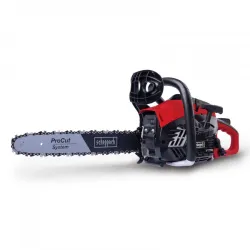
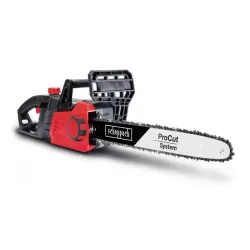
Petrol models are independent of a power socket and are usually intended for more serious, longer work. The trade-offs are fuel, maintenance and more noise. Corded electric saws are easier to start and handy in the yard if a socket is nearby. Battery models are quieter and convenient for occasional use, but run time depends on the battery.
There is no universal winner — it all depends on your situation. A full comparison with a table and scenarios is in the article petrol, electric or battery chainsaw.
Guide bar length: longer is not better
The bar determines how thick a tree you can cut through, but the actual cutting length is always shorter than the stated bar length. A longer bar also means more weight, harder handling and higher power requirements. If you cut branches and small trunks, a 20–35 cm bar is often more comfortable than a long one. If the job is thick logs, choose a bar with some reserve, but always check the cutting length recommended by the manufacturer.
Examples from the range: BC-TCS200-X — 20 cm bar (supplied without a battery), PCS38 — 35 cm, and for bigger jobs look at the 45–51 cm class described in the article chainsaw for firewood.
Power and weight: look for balance
More power lets you cut thicker wood faster, but it often comes with more weight and noise. If you cut rarely and only small amounts, an over-powered tool becomes a burden: your arms tire and control drops. If, on the other hand, the tool is too weak, it works at its limit and safety suffers.
How to compare: look at the power in W or kW on the card together with the bar length. For example, PCS38 has a 35 cm bar and 1.3 kW, while CSE2700 is an electric model with 2700 W. Check weight and other data on the product card.
Mini and arborist models for branches
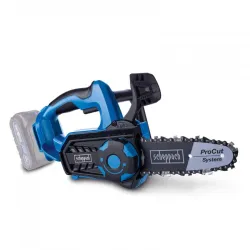
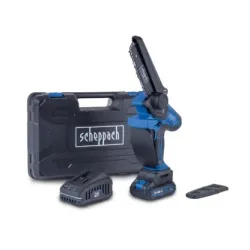
If your main jobs are trimming branches and caring for hedges and fruit trees, small models are often the more sensible choice. They are lighter and easier to handle. Examples: BC-PS150-X — mini arborist battery version (kit), DCK 30 cm — 20 V kit with a 30 cm bar. More about garden work in the article chainsaw for the garden.
Firewood or garden — two different jobs
- Firewood: bar length, power and the ability to work longer matter. See how to choose for firewood.
- Garden: light weight, handling and simple use matter. See how to choose for the garden.
- Maintenance: for any type the chain must be kept in good order — how to maintain a chainsaw chain.
Model examples with explanations
| Model | Type | Why consider it |
|---|---|---|
| Scheppach PCS38 | Petrol, 35 cm, 1.3 kW | Mid-range class for home and rural work where there is no socket |
| Scheppach CSE2700 | Electric, 2700 W | Convenient in the yard if a socket or extension lead is nearby |
| Scheppach BC-TCS200-X | Battery, 20 cm, without battery | Small, light option for branches; if you already have compatible batteries |
| Scheppach BC-PS150-X | Mini arborist, kit | For pruning branches where handling matters |
| DCK 30 cm | Battery, 20 V, kit | An in-between option between a mini and a larger saw |
| HiKOKI CS1825DC | HiKOKI chainsaw | An option for those who already use the HiKOKI system — data on the card |
Before choosing, compare the data with the product card and check availability, as some models may be temporarily sold out.
How to read a product card without getting lost
- Bar length — sets the maximum cut size, but the real cut is smaller.
- Power (W or kW) — compare only between similar types; petrol and electric saw power ratings are not directly comparable.
- What is included — for battery models check whether a battery and charger are included; “bare” means the saw only.
- Power source — fuel, 230 V cord or a battery system.
- Availability — stock status and delivery time change; see the card.
If something on the card is unclear, ask a consultant before buying. That is faster than an exchange after delivery.
Typical scenarios
“I have two apple trees and a fence to trim once a year.” A large petrol saw would be overkill. Consider a mini or battery model, for example BC-TCS200-X or BC-PS150-X.
“Every autumn I prepare firewood for my two fireplaces.” Here you need to think about a stable mid-range class and a bar reserve. Start with the article chainsaw for firewood.
“The house has a yard, a shed and a socket, but I don’t want to deal with fuel.” A corded electric model, for example CSE2700, is one option.
“I already have HiKOKI or DCK battery tools.” Then it is worth looking at compatible models, because a battery system can pay off, but always check compatibility on the card.
Typical mistakes when choosing
- Buying by maximum power without thinking about weight.
- Choosing a bar that is too long “just in case”.
- Forgetting about chain oil, a spare chain and protective equipment.
- Not checking whether a battery model includes a battery.
- Thinking you can use a saw without training or reading the manual.
Safety is not an afterthought
A chainsaw is a dangerous tool, so plan protection together with the purchase. The minimum: a helmet with face and ear protection, protective gloves, cut-protection trousers or footwear with cut protection. For an overview of the range see the article protective equipment.
- Always hold the saw with both hands.
- Know what kickback is, and never cut with the tip of the bar unless the manual allows it.
- Check that the chain brake works before you start.
- Follow only the manufacturer’s manual — it matters more than any article on the internet.
Before you buy — a short checklist
- Write down your main jobs and how often you do them.
- Decide on the type: petrol, electric or battery.
- Choose the bar by the size of your trees, not “with a reserve for ever”.
- Consider the weight — try to imagine working with it for an hour.
- Prepare protective equipment and chain oil.
- On the product card, check the specification, what is included and availability.
Frequently asked questions
Is more power always better?
No. An over-powered tool is heavier and harder to control. Choose by the job.
Is a battery chainsaw suitable to start with?
If the jobs are small and infrequent, it is often a convenient option. Check whether a battery is included — some models are supplied without one.
Can one saw do everything?
Rarely. Many people choose a middle-of-the-road solution and accept a compromise. If your jobs differ a lot, it can be sensible to choose two tools of different sizes.
Full range: Chainsaws.


Reviews
Be the first to review this article.
Write a review