
Residual current protection under LBN 261-15: where 30 mA and 300 mA are mandatory
Residual current protection (RCD, RCCB, RCBO) is one of the few electrical installation topics where the Latvian building code is very specific. Amendments to LBN 261-15 came into force in July 2025, and many websites still carry old or simplified information. This guide covers three things: what the regulation requires, what standards and manufacturers recommend, and how to turn it into a list of devices.
Important: this is information, not a design. Electrical installations are designed, installed and tested by certified specialists. We use three labels: LBN — mandatory requirement, standard — an applicable standard from the LVS list, recommendation — a manufacturer's advice or our own conclusion.
What LBN 261-15 requires: three points
The building code for internal electrical installations was approved by Cabinet Regulation No. 294 (2015). The residual current points are worded as per Cabinet Regulation No. 355 (17.06.2025), in force from 1 July 2025. Below is a summary; read the original text on likumi.lv.
| Point | Where | Requirement |
|---|---|---|
| 28.1 (1) | General-purpose sockets up to 32 A used by persons without electrical training | Residual current protection with rated residual operating current not exceeding 30 mA |
| 28.1 (2) | Sockets up to 32 A for mobile equipment used outdoors | Not exceeding 30 mA |
| 28.1 (3) | Lighting circuits in household installations | Not exceeding 30 mA |
| 28.2 | Main incoming board of an individual dwelling house, on the common incomer | 300–500 mA or an alternative technical protection solution |
| 28.3 | The whole installation | Device class chosen according to the type of connected equipment |
So the regulation sets where and what sensitivity, but not the specific device, number of poles, or whether to use a shared RCD or an RCBO. That is the designer's choice based on standards and manufacturer data.
What this means for a flat and a house
Socket circuits
Ordinary sockets (up to 32 A) in a flat, house, office or shop used by people without electrical training must be protected by a 30 mA device (LBN 28.1 (1)). Outdoor sockets for mobile equipment — a lawn mower, a pressure washer, an extension lead to the terrace — as well (28.1 (2)).
Lighting
In household installations the 30 mA requirement also covers lighting circuits (28.1 (3)). Our practical conclusion: when planning a board for a flat or house, connect lighting circuits behind a 30 mA device just like sockets, not "straight from the breaker".
Incomer of a private house
In the main incoming board of an individual dwelling house, 300–500 mA protection or another technical solution is required on the common incomer (28.2). This device is not meant to protect a person from direct contact — its job is to disconnect larger leakage across the installation. That is why 30 mA devices are still needed on the circuits.
Does an existing installation have to be rebuilt
The code applies to design and installation. Point 4 of Cabinet Regulation No. 294 states that construction documentation already approved or submitted for approval need not be revised when the technical rules change. Whether a board replacement in an existing house must follow the new wording depends on the scope of works and the design — ask the designer.
Which RCD type: what point 28.3 means
The code requires choosing the device class by the type of connected equipment. The classes are AC, A, F and B. In short: AC responds only to sinusoidal AC leakage, A also to pulsating DC from electronics with rectifiers, F also to mixed-frequency leakage from single-phase frequency converters, B also to smooth DC from three-phase converters. A modern home has electronics on almost every circuit (LED drivers, chargers, inverter appliances), so manufacturers recommend type A as the baseline, and F or B for specific equipment as per its manual. Details with a table: RCD type AC, A, F or B.
RCD or RCBO
There are two common ways to meet the 30 mA requirement.
| Shared RCD for several circuits | RCBO per circuit | |
|---|---|---|
| Device | RCCB (no overcurrent protection) + MCBs | RCBO — leakage + overload + short circuit in one |
| On a leakage fault | All circuits behind this RCD switch off | Only one circuit switches off |
| Board space | Less space with many circuits | Some compact 1P+N RCBOs take 1 module, others 2 (check the card) |
| Cost | Lower | Higher |
| Background leakage | Leakage from several circuits adds up | Each circuit has its own |
In practice the two are often combined: sockets and lighting are split across several 30 mA RCDs so that one fault does not black out the whole house, while critical circuits (boiler, freezer, pump, outdoor sockets) get their own RCBOs. Manufacturer guidance (Schneider Electrical Installation Guide): the sum of standing leakage behind one device should be well below its operating current, otherwise nuisance tripping follows.
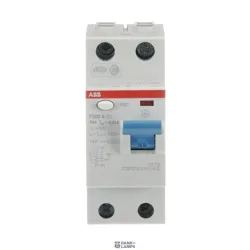
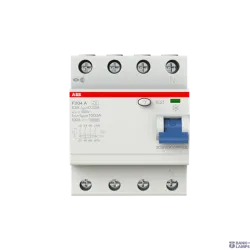
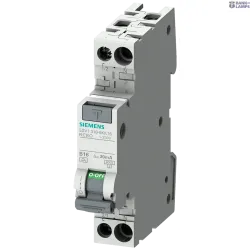
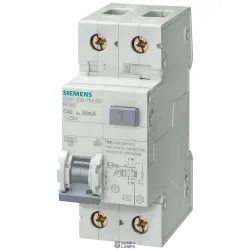
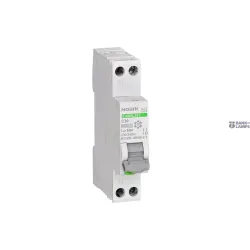
Examples from the range: 2-pole RCD ABB F202 A-40/0.03 (type A, 40 A, 30 mA), 4-pole ABB F204 A-63/0.03 (type A, 63 A, 30 mA), RCBOs Siemens 5SV1316-6KK16 (B16, type A, 30 mA, 1P+N), Siemens 5SU1356-7KK16 (C16, type A) and Noark Ex9BL20J B10.
Important: an RCD (RCCB) by itself does not protect against overload and short circuit. The manufacturer states which overcurrent protection it must be combined with — see the datasheet.
Selectivity: 300 mA at the incomer, 30 mA on circuits
If a private house has a 300 mA device at the incomer and 30 mA on circuits, both should not trip at once. Manufacturer guidance (Schneider Electrical Installation Guide, ABB) for selectivity:
- the upstream device's rated residual current at least three times that of the downstream one;
- the upstream device with a time delay — type S (selective).
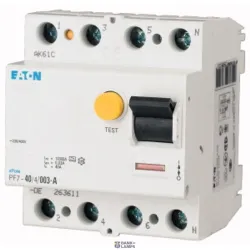
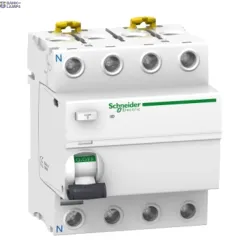
That is why type S devices are used at the incomer: ABB F204 A S-63/0.3 (4P, 63 A, 300 mA, type A, S), Eaton PF7-40/4/03-S/A (4P, 40 A, 300 mA, S/A). Schneider iIDK 4P 63 A 300 mA A-SI is a 300 mA device with increased immunity to nuisance tripping (manufacturer's SI marking); check the datasheet to see whether it is selective. If an "alternative solution" is chosen instead of 28.2, the designer justifies it.
What to check before buying
- Poles: 2P for single-phase, 4P for three-phase circuits. LBN 8.3: dwellings with an incoming protection above 32 A are connected three-phase only.
- Rated current (In): the RCD rating must be coordinated with the upstream overcurrent protection per the manufacturer's table.
- Residual operating current (IΔn): 30 mA for personal protection, 300 mA for the incomer.
- Type (AC/A/F/B): by equipment (28.3).
- Type S for the upstream device if selectivity is needed.
- Board space: module count — see distribution board bill of materials.
- Origin: buy from traceable sources — manufacturers warn about counterfeit protective devices.
What this article does not replace
Residual current protection is only one protective measure. Point 25 of LBN 261-15 also lists overcurrent, lightning current and overvoltage protection — for the latter see surge protection in the distribution board. After installation, points 53.4 and 55 require measurements (insulation, phase–neutral loop, earthing, bonding) carried out by a certified electrical specialist.
Do not work on live equipment, and do not disconnect protective devices to stop them "tripping". Frequent RCD tripping means leakage or a fault that an electrician must find.
Sources and date checked
- LBN 261-15 (Cabinet Regulation No. 294, 2015), points 4, 8.3, 25, 28.1–28.3, 53–55; amended by Cabinet Regulation No. 355 (2025). Checked on likumi.lv on 18 October 2026.
- LVS list of applicable standards for LBN 261-15 (Ministry of Economics order, in force from 09.01.2026) — incl. LVS HD 60364-4-41:2017.
- Schneider Electric Electrical Installation Guide — RCD types and selectivity; ABB RCCB FAQ.
Check all device specifications on the product card and in the manufacturer's datasheet. For availability and price see the circuit breakers and RCDs category.
Related products
Reviews
Be the first to review this article.
Write a review