
RCD type AC, A, F or B: how to choose by the connected equipment
On an RCD housing next to 30 mA or 300 mA there is a small symbol or letter: AC, A, F or B. It is not a price tier or a quality class. The type determines which residual current waveform the device can detect. If the device cannot detect it, it may fail to trip when leakage occurs. That is why point 28.3 of LBN 261-15 requires choosing the device class by the type of connected equipment.
Where residual current protection is mandatory and what sensitivity is needed is covered in the main article residual current protection under LBN 261-15. Here — only types.
The four types in brief
Classification per IEC 60755 and manufacturer documentation (Schneider Electrical Installation Guide, ABB). Each type also detects everything the previous one does.
| Type | Detects | Typical sources |
|---|---|---|
| AC | Sinusoidal AC leakage | Resistive loads without electronics: heating elements, incandescent lamps |
| A | + pulsating DC (with a small smooth DC component, manufacturers usually state up to 6 mA) | Single-phase electronics with a rectifier: LED drivers, chargers, computers, household appliances |
| F | + mixed-frequency leakage, smooth DC usually up to 10 mA | Single-phase frequency converters: inverter washing machines and air conditioners, single-phase variable-speed pumps |
| B | + smooth DC and higher frequencies | Three-phase frequency converters, some three-phase heat pumps, inverters and chargers when their manufacturer requires type B |
Why it matters: smooth DC leakage can "saturate" a type A or AC device, so it may fail to trip even when ordinary leakage occurs at the same time. That is why manufacturers state that a circuit intended for type B equipment must not be connected downstream of a type A or AC device if the upstream device would then be unable to operate.
The main rule: check the equipment manual
The most reliable source is the installation manual of the connected equipment. Manufacturers of heat pumps, frequency converters, inverters and chargers often state directly: "use a type B RCD" or "type A is sufficient". If the manual has a requirement, it overrides any general table.
Without a manual, guidance from the Schneider Electrical Installation Guide (summary):
| Load | Minimum type (recommendation) |
|---|---|
| Heating elements, water heater without electronics | AC (or A) |
| Ordinary sockets in a home, LED lighting | A |
| Washing machine, dishwasher with an inverter motor | A or F — per manufacturer |
| Single-phase air conditioner or heat pump with an inverter | F or per manufacturer |
| Three-phase frequency converter, three-phase heat pump | B or per manufacturer |
| EV charging | B, or A + DC leakage monitoring (RDC-DD) if built into the charger |
About EVs: LEVA guidance mentions type B or type A combined with 6 mA DC leakage monitoring for charging. From 1 August 2026 EV charging requirements have moved from LBN 261-15 to LBN 200-21. We do not currently sell chargers.
Is type AC banned?
The common claim "type AC is banned in the EU" is not accurate. LBN 261-15 does not ban type AC — it requires choosing the class by equipment. Manufacturers (e.g. ABB) note that modern household installations have electronics almost everywhere, so type A is a sensible baseline for sockets and lighting. Type AC may only suit purely resistive loads. Our conclusion: if you do not know what will be connected, choose at least type A.
Examples in the range
| Model | Type | Poles / In / IΔn |
|---|---|---|
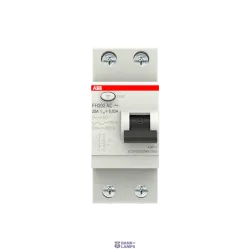
| ABB FH202 AC-25/0.03 | AC | 2P / 25 A / 30 mA |
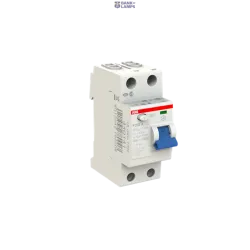
| ABB F202 A-25/0.03 | A | 2P / 25 A / 30 mA |
| ABB F202 A-40/0.03 | A | 2P / 40 A / 30 mA |
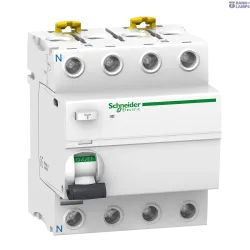
| Schneider iIDK A9R61440 | A-SI | 4P / 40 A / 30 mA |
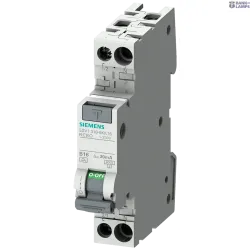
| Siemens 5SV1316-6KK16 (RCBO) | A | 1P+N / B16 / 30 mA |
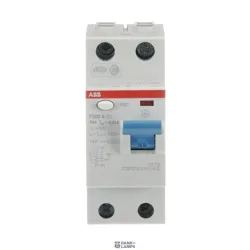
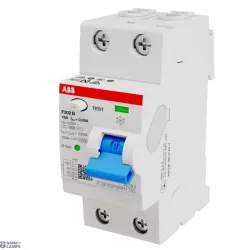
| ABB F202 B-16/0.03 | B | 2P / 16 A / 30 mA |
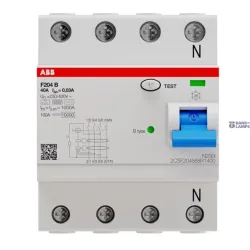
| ABB F204 B-40/0.03 | B | 4P / 40 A / 30 mA |
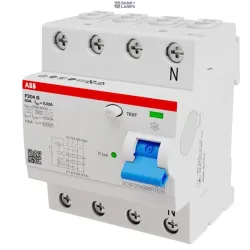
| ABB F204 B-63/0.03 | B | 4P / 63 A / 30 mA |
Type B devices cost several times more than type A — compare prices on the cards. So type B goes only on the circuits that actually need it, not on the whole board. We currently have no type F devices in the range.
Common mistakes
- Type AC for the whole house because it is cheapest — it may be unsuitable for modern electronics.
- Type B equipment downstream of a type A RCD — the upstream device may lose sensitivity.
- Type chosen "by eye" without checking the heat pump or converter manual.
- Confusing it with type S: S means selective (time-delayed), not a waveform class. A device can be "A S" — class A and selective.
Sources and date checked
- LBN 261-15, point 28.3 (as worded by Cabinet Regulation No. 355). Checked on likumi.lv on 18 October 2026.
- Schneider Electric Electrical Installation Guide — Types of RCDs (IEC 60755 classification, load table).
- ABB — RCCB FAQ; LEVA guidance on EV charging.
Continue with the distribution board bill of materials. All devices are in the circuit breakers and RCDs category.
Related products
Reviews
Be the first to review this article.
Write a review