
Distribution board bill of materials: a specification for a flat and a private house
The distribution board (consumer unit, fuse board) is where the whole installation meets: the incomer, protection, circuits, neutral and protective conductors. A specification error usually means one of three things: the enclosure is too small, an item is forgotten (busbar, N/PE terminals, surge protection), or the devices are not compatible. This guide helps you compile a complete bill of materials and check it before ordering.
This is not a board design method. Protective device ratings, conductor sizes and selectivity are set by the designer. LBN 261-15 point 55: electrical installation is carried out under the supervision of a certified construction specialist.
Input data you need first
- Supply: single-phase or three-phase, and the incoming protection rating from the network operator's technical conditions. LBN 8.3: dwellings above 32 A — three-phase only.
- Earthing system: TN-C-S or TT — it determines the surge protection scheme and N/PE arrangement.
- Building type: flat or individual dwelling house (point 28.2 — 300–500 mA at the incomer of a private house).
- Circuit list: lighting, sockets, kitchen, cooker, water heater, boiler or heat pump, outdoor sockets, garage, workshop.
- Equipment with electronics: inverters, frequency converters — affects the RCD type.
- Location: flush or surface, dry room or basement, garage, outdoor shelter — affects the IP rating.
Specification items
| Item | Function | What to check | Example in the range |
|---|---|---|---|
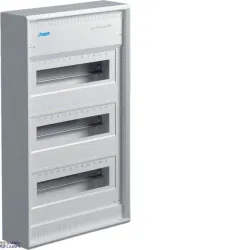
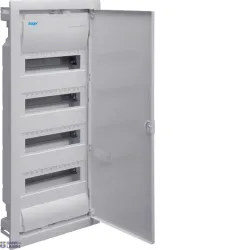
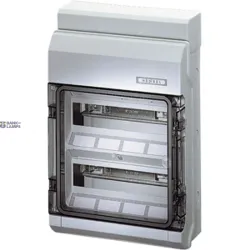
| Enclosure | Houses devices, busbars and terminals | Modules, rows, rated current, IP, flush/surface | Hager VA36B, Hager VU48NE, Hensel KV 9224 |
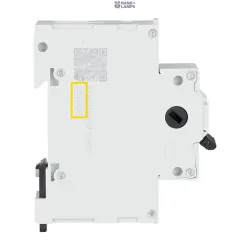
| Main switch | Isolates the whole board for maintenance | Poles, In, category | Eaton IS-40/3 |
| Surge protection | Atmospheric and switching overvoltages | Type, earthing system, backup protection | see the surge protection article |
| Incomer residual protection (private house) | 300–500 mA on the common incomer | Type S for selectivity | ABB F204 A S-63/0.3 |
| Circuit residual protection | 30 mA for sockets and lighting | Type, poles, In | ABB F204 A-63/0.03, RCBOs |
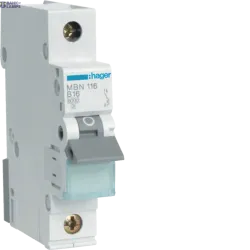
| MCBs | Circuit overload and short circuit | Curve, In, Icn, poles | Hager MBN116 (B16, 6 kA) |
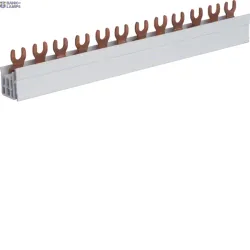
| Busbar | Feeds a row of devices | Poles, comb type, length in modules, current, compatibility | Hager KDN363A |
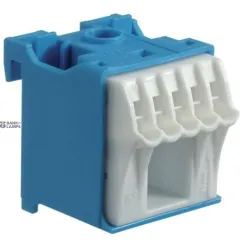
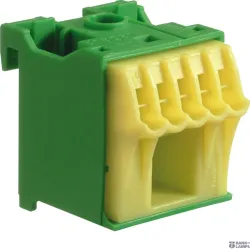
| N and PE terminals | Neutral and protective conductor connections | Number of terminals vs number of circuits | Hager KN06N, Hager KN06E |
| Labels and blanking covers | Circuit names, covering unused modules | Per enclosure maker | per enclosure system |
How to count modules
Modular devices are measured in modules (one module is 17.5–18 mm on a DIN rail). The values below are typical — check the exact width on each device's card or datasheet.
| Device | Typical width |
|---|---|
| MCB 1P | 1 module (e.g. MBN116) |
| MCB 1P+N compact | 1 module (Hager MLN516) |
| MCB 3P | 3 modules |
| RCD 2P / 4P | 2 / 4 modules |
| RCBO 1P+N | 1–2 modules depending on model |
| Main switch 3P | usually 3 modules |
| Surge protection 3+1 (Dehn DG M TT 275) | 4 modules (datasheet) |
Illustrative example, not a design. Private house, three-phase supply, 14 circuits: main switch 3P (3), surge protection 3+1 (4), incomer 300 mA S 4P (4), two 30 mA 4P RCDs (8), twelve 1P MCBs (12), one 3P MCB for the cooker (3). Total 34 modules. A 36-module enclosure would leave only 2 spaces, so for this list we would choose a 48-module enclosure such as Hager VU48NE (4×12).
Spare space: LBN 261-15 point 12.1 requires enough space for initial installation and later replacement of components. The regulation gives no percentage. Our recommendation: plan roughly 20–30% free modules for future circuits (heat pump, solar panels, workshop).
Enclosure: how to choose
| Model | Mounting | Modules | IP |
|---|---|---|---|
| Hager VU12NE | Flush | 1×12 | IP30 |
| Hager VA36B | Surface | 3×12 | IP30 |
| Hager VU48NE | Flush | 4×12 | IP30 |
| Hensel KV 9112 | Surface, with terminals | 1×12 | IP65 |
| Hensel KV 9224 | Surface, with terminals | 2×12 | IP65 |
For the Hager Volta series the manufacturer states 63 A rated current and IP30 — suitable for dry rooms. For a garage, basement or shelter with moisture or dust, an IP65 enclosure such as Hensel is more suitable. Door, frame and accessory details vary by model — check the card.
Can brands be mixed?
In practice boards often contain devices from several brands. Switchgear assemblies fall under the LVS EN 61439 series. The LEVA guidelines for selecting low-voltage board parameters (v1.1, 2026) stress that responsibility for the board's compliance lies with its manufacturer — whoever assembles and verifies it. When devices from another manufacturer are used, the enclosure maker's conditions must be followed and heat dissipation checked as well.
Our recommendations:
- Choose busbars and devices from one system, or check that the comb shape and pitch fit (e.g. Hager KDN busbars are intended for Hager devices).
- Do not combine devices whose terminal design does not fit the busbar comb.
- Make sure the total board load does not exceed the enclosure's rated current.
Pre-order checklist
- All circuits listed, each with a protective device.
- Sockets and lighting are behind 30 mA protection (LBN 28.1).
- In a private house the incomer has 300–500 mA or a justified alternative (28.2).
- RCD type matches the equipment (28.3) — see RCD types.
- MCB Icn is not lower than the prospective short-circuit current (calculated by the designer).
- The surge protection scheme matches the earthing system.
- Enough N and PE terminals.
- Total modules + spare ≤ enclosure capacity.
- IP rating suits the room.
- Devices bought from a traceable source.
Documentation and handover
When a building is put into service, LBN 261-15 point 53 requires as-built documentation, equipment passports and measurement reports (point 53.4: insulation resistance, phase–neutral loop, earthing and bonding). These measurements are carried out by a certified electrical specialist. The fire safety regulations (Cabinet Regulation No. 238) require periodic inspection of the electrical installation.
Our recommendation: keep a circuit list and diagram at the board, so it is clear later what is on which device.
Sources and date checked
- LBN 261-15, points 8.3, 12, 28.1–28.3, 53–55. Checked on likumi.lv on 18 October 2026.
- LEVA "Guidelines for selecting low-voltage distribution board parameters" v1.1 (09.02.2026).
- Hager Volta technical information; Dehn DEHNguard M datasheets.
See devices in the distribution boxes and boards, circuit breakers and RCDs and terminals and connectors categories. On 30 mA and 300 mA requirements: residual current protection under LBN 261-15.
Reviews
Be the first to review this article.
Write a review