
Choosing an MCB: trip curve B, C or D, In and Icn
A miniature circuit breaker (MCB) in a dwelling board protects the cable and equipment against overload and short circuit. Search results often show universal tables “B for homes, C for workshops, D for motors”. Those tables are not a requirement of LBN 261-15 and they do not replace a design. This guide explains the curve, rated current and breaking capacity, and which inputs you need before you order a device.
This is information, not a design. Installations are designed, installed and tested by certified specialists. Labels: LBN — mandatory, standard — an applicable standard, recommendation — manufacturer or our conclusion.
What LBN 261-15 requires — and what it does not
Point 20 of LBN 261-15 (checked on likumi.lv on 18 October 2026) says the conductor cross-section is chosen from allowable temperature (Annex 4 Table 1), voltage drop, electro-mechanical stresses in a short circuit, and the maximum impedance needed for earth-fault and short-circuit protection to operate. Point 21 points to the minimum cross-sections in Annex 4. The code does not specify curve B/C/D and does not say that a 16 A breaker “always matches 1.5 mm² cable”.
Our conclusion: cable current-carrying capacity in the actual installation method and disconnection conditions come first; then In and the curve. We do not add a second cable-sizing calculator — those already exist in Latvia; we list the inputs the designer uses.
Rated current In
In is the current the device can carry continuously per the manufacturer. A common design principle (standards / manufacturer guides, not LBN wording): the protective device rating stays between load current and the cable’s allowable current. If In exceeds the cable’s capacity in that installation, the cable is not protected. We do not give millimetres and amperes here — they depend on insulation, temperature, grouping and installation method.
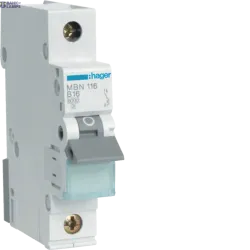
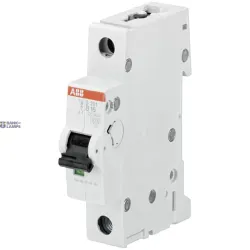
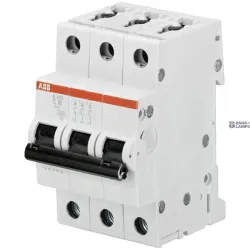
Examples (ratings from the card): Hager MBN116 (1P, B-16 A, 6 kA on the card), ABB S201-B16 (1P, B, 16 A), ABB S203-C16 (3P, C, 16 A). Check availability on the card — a supplier’s nominal quantity is not confirmed INVENTARS warehouse stock.
Curves B, C, D
IEC 60898-1 defines the instantaneous (magnetic) trip band. Manufacturer documentation (ABB MCB curves, 2CDC400002D0201) summarises:
| Curve | Magnetic band (× In) | What it means in practice |
|---|---|---|
| B | 3–5 · In | Trips on a relatively small inrush; often used on resistive or moderate loads. Not “for every dwelling”. |
| C | 5–10 · In | Higher inrush before magnetic trip. Often mixed loads with electronics or small motors — if the calculation supports it. |
| D | 10–20 · In | Still higher inrush. Typical of equipment with large starting current. Not a default for household sockets. |
These bands are standard / manufacturer data, not an LBN table. They do not ban B in a workshop or mandate C for a whole flat. If the magnetic band is too high, a fault at the far end of the circuit may not disconnect in time — that is checked with loop impedance and Icn, not by habit.
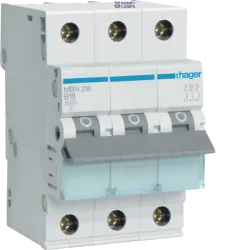
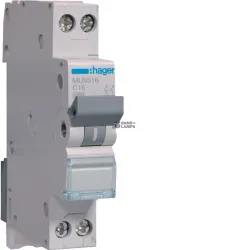
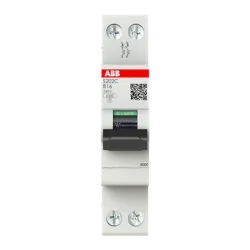
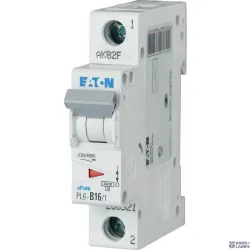
Examples: B — Hager MBN116, Hager MBN316 (3P, B-16 A, 6 kA on the card), Eaton PL6-B16/1 (1P, B, 16 A; Icn is not on the card — use the datasheet). C — Hager MLN516 (1P+N, C-16 A, 6 kA, 1 module). D — ABB S201-D10 (1P, D, 10 A). ABB S200C Enhancement 2P 16 A B states 6 kA at 230 V on the card — we quote Icn only where the card states it.
Icn: breaking capacity
Icn (IEC 60898-1) is the rated short-circuit breaking capacity. The device must be able to break the prospective short-circuit current at the point of installation. The designer calculates that from network data; it is not “6 kA for every flat”. If Icn is missing on the card, take it only from the datasheet. In this range, 6 kA is explicit on the Hager MBN/MLN examples and on ABB S200C Enhancement 2P 16 A B; the ABB S201/S203 and Eaton PL6 cards cited here do not state Icn.
Number of poles
- 1P — interrupts one pole (usually the phase). N stays connected unless the scheme requires otherwise.
- 1P+N — phase and neutral in one device; Hager MLN516 is 1 module on the card.
- 3P — three phases, no N. Hager MBN316, ABB S203-C16.
- 3P+N / 4P — when the neutral must also be interrupted; that comes from the scheme and standards, not this page.
LBN 261-15 8.3: dwellings with incoming protection above 32 A are connected three-phase only. That is about the building connection, not “fit 3P MCBs everywhere”.
What to check before buying
- Load type and inrush (designer / equipment datasheet).
- Cable type, installation method, allowable current — inputs of LBN points 20 and 21.
- In coordinated with cable and load.
- Curve B/C/D from inrush and disconnection conditions, not from habit.
- Icn versus prospective short-circuit current at the location.
- Poles and module width — distribution board bill of materials.
- Whether the group also needs residual current protection — LBN 28.1–28.3.
We do not declare a universal “B16 for every socket” and we do not publish wiring diagrams. Do not work live. For motor circuits with contactors see motor protection and contactors — an MCB is not a motor-protective circuit breaker.
Sources: LBN 261-15 points 8.3, 20, 21 and Annex 4 (likumi.lv 18 Oct 2026); IEC 60898-1 via ABB 2CDC400002D0201; In/poles/Icn only from the cited cards. Range: circuit breakers and RCDs.
Related products
Reviews
Be the first to review this article.
Write a review