
Motor protection and contactors: MPCB, overload relay and AC-3

A motor circuit usually has three jobs: overload protection, short-circuit protection and switching. They can be combined or split. A common mistake: fitting a household C-curve MCB and assuming the motor is protected.
Information, not a design and not a start-up procedure. Motor circuits are designed and set by a certified specialist. Labels: LBN, standard, manufacturer recommendation.
Three devices, three jobs
| Device | What it does | What it does not do alone |
|---|---|---|
| Motor-protective circuit breaker (MPCB, MMS) | Thermal-magnetic protection: overload + short circuit; often an adjustable thermal setting in the motor FLC range | Not a contactor for remote switching; not an RCD |
| Contactor | Frequent on/off via a coil; withstands motor starting current if the utilisation-category rating is correct | Usually no overload protection (except combinations) |
| Thermal overload relay | Overload protection, often mounted on the contactor | Not the short-circuit breaking capacity in place of the combination |
Manufacturer recommendation (Eaton PKZ, ABB Manual motor starter Guide): set the MPCB thermal adjustment to the motor full-load current on the nameplate, within the device range. We do not declare amperes “for every 4 kW motor”.
Examples from the range
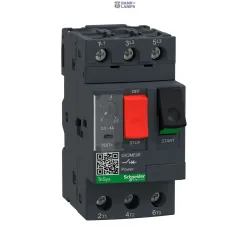
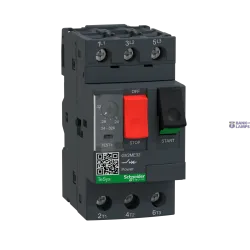
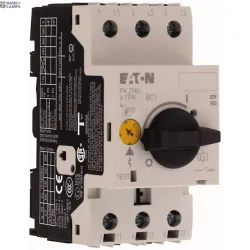
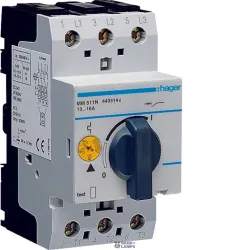
MPCB: Schneider GV2ME08 (TeSys GV2, 3P, 4 A, 100 kA on the card, screw terminals, push-buttons), Schneider GV2ME32 (3P, 32 A, 50 kA on the card), Eaton PKZM0-10 (6.3–10 A, 4 kW on the card), Hager MM511N (3P, 10–16 A, 4/7.5 kW at 230/415 V on the card). kA/kW quoted only from the card text.
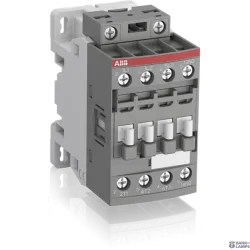
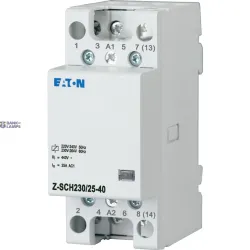
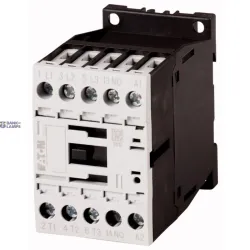
Contactors: ABB AF16-30-01-13 (coil 100–250 V AC/DC — a power contactor, not a DIN installation contactor), Eaton DILM9-10 (9 A, 4 kW, 3P+1NO, 24 V AC coil on the card). An installation contactor for lighting or heat is different: Eaton Z-SCH230/25-40 (25 A, 4NO, 230 V AC; 2 HP on the card) — we do not invent an AC-3 kW figure for that card.
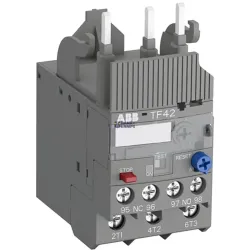
Overload relay: ABB TF42-20 (16…20 A). Another TF42 in this series is tied on the card to AF38…AF52 — check the manufacturer table for mechanical and electrical fit.
AC-1 and AC-3
IEC 60947-4-1 utilisation categories (standard, not LBN): AC-3 is motor starting and breaking during running; AC-1 is non-inductive or slightly inductive load. For the same contactor, AC-3 current is usually lower than AC-1. If the card only says “25 A” without a category, do not treat it as a 25 A motor rating.
Type 1 / Type 2 coordination
IEC 60947-4-1 coordination between contactor, overload relay and short-circuit protection is a manufacturer table. Type 2 means the combination remains usable after a short circuit without replacing parts (within allowed contact welding); Type 1 allows devices to be replaced after a short circuit provided persons are not endangered. We do not copy those tables and we do not claim GV2ME08 + AF16 is Type 2 “by default”.
MPCB versus household MCB
An MCB B/C/D protects the cable on an IEC 60898-1 curve. Motor starting current of several times FLC may trip a C-curve, but a D-curve is not an MPCB: it has no thermal setting to motor FLC. LBN 261-15 does not say “fit an MPCB on every motor” — that is equipment and product standards.
No star-delta steps, no bypass of protection, no live work. Availability: see the card. Devices: relays and timers and circuit breakers and RCDs.
Sources: LBN 261-15 point 25 (general protective functions; no separate MPCB clause), checked 18 Oct 2026; IEC 60947-4-1 via Eaton PKZ, ABB 2CDC131060M0202, Eaton Z-SCH / DILM cards.
Related products
Reviews
Be the first to review this article.
Write a review