
How to choose a radiator for the home

A radiator is a heat “window” in the room: through it heating water gives heat to the air. If you choose only by the “nicest white rectangle” or the longest mm, you risk a cold room or a unit that does not fit the niche. This guide teaches how to choose a radiator step by step — then look at concrete models in the inventars.lv range.
Heating map overall: heating and hot water. Besides the radiator you often also need valves and sometimes a circulation pump.
Start with three questions
- How large is the room and how well does it hold heat? A corner room with large windows “eats” more heat than an internal room with good insulation. Output (W) is primary — not “length because that is what the old one was”.
- What space is there on the wall? Under a window 300–500 mm height often fits; length — as much as the niche allows, leaving room for valves at the sides.
- What is the connection? Bottom, side, centre — must match pipe layout. On renovation, photograph existing outlets before ordering.
Type: C11, C22 and sections
| Type | Meaning | When typical | Example |
|---|---|---|---|
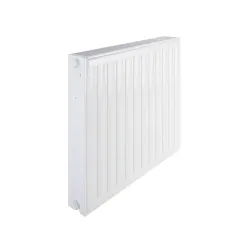
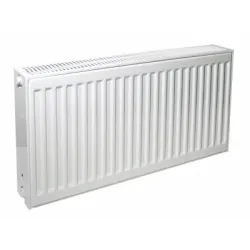
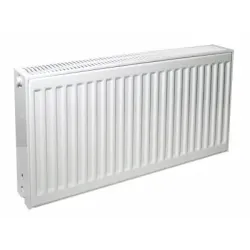
| C11 (panel) | One panel + convector | Smaller/medium rooms, typical hydronic heating | Purmo C11 300×400, C11 400×400, C11 500×400, C11 500×500, C11 500×600 |
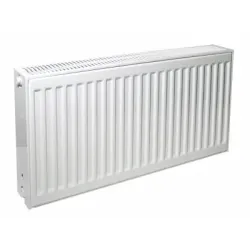
| C22 (panel) | Two panels + convectors — more output in the same footprint | When you need more W in the same “frame” | IMAS C22 500×500 |
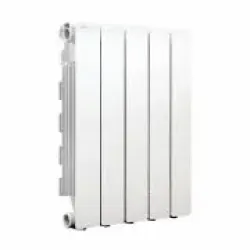
| Sectional (aluminium etc.) | Built from sections; different mounting/extension style | When the project/renovation needs sectional logic | Fondital Simun 4 sections |
Detailed comparison: panel or sections.
Sizes: height × length
On the card you almost always see height × length (mm). Height is often 300 / 400 / 500 / 600 mm — depends on the sill and niche. Length (400, 500, 600…) sets how “wide” the unit fits under the window. Longer ≠ automatically “better”: type and output (C11/C22) decide heat; length — space.
Practically in the Purmo C11 line at one height (500 mm) you can compare lengths: 500×400, 500×500, 500×600. Low niche: C11 300×400. When you need more output in the same 500×500 “box”, see C22: IMAS C22 500×500.
Output and “how many W you need”
The manufacturer card lists heat output at defined temperature regimes (ΔT). Without a project, a rough guide: a colder corner room with large windows needs more W per m² than a well-insulated internal one. Better: take the old radiator data / project numbers, not “buy obviously the biggest”.
If the system is large and radiators do not heat evenly, the problem may not be “too small radiator” but circulation — when you need a circulation pump.
Valves — do not leave the radiator “naked”
A thermostatic valve and return valve let you regulate the room and service the unit. See how to choose valves and what a thermostatic valve means. Kit example: Danfoss line in Radiator valves.
Typical mistakes
- Buying only by length mm, ignoring type (C11 vs C22) and output.
- Replacing the old radiator with a “nicer” one but leaving the wrong connection.
- Forgetting space for side valves — the radiator “does not fit” the niche by 2–3 cm.
- Mixing panel and sectional logic without a mounting plan.
- Expecting the radiator to “fix” poor circulation without a pump/hydraulics.
Short path to buying
- Photograph the niche, measure height to the sill and connection layout.
- Pick type (panel C11/C22 or sections) — comparison.
- Choose 2–3 cards with similar output and size; compare connection.
- Add valves and, if needed, check the pump.
Range: Radiators. Brands in examples: Purmo, Imas, Fondital. Pillar: heating map.
FAQ
Is C22 always better than C11?
No. C22 gives more output per area but is thicker/heavier and costlier. If C11 with the right length covers the need — enough.
Can I take “the same mm” as the old one?
Mm is space. Output and type can differ. Better compare W and connection, not only length.
Do I need a thermostatic head?
Almost always yes if you want room-by-room control. See thermostatic valve.
Reviews
Be the first to review this article.
Write a review