
How to choose a compressor?
If you stand in front of air compressors and only compare “8 bar” or “50 litres”, you can easily buy something too big, too small, or simply wrong. A compressor is not “bigger is better”. It is an air source for a specific job — and the job decides how much air you need, for how long, and how quietly.
This guide is practical: how to think before you look at price. Examples are from the inventars.lv range (Scheppach, Ecomax). We skip prices here — they change; the numbers on the card and what you do on a Tuesday evening in the garage matter more.
Start with the job, not the catalogue
Before any bar or litre comparison, answer three questions. If the answers are fuzzy, the choice will almost always be random.
- What uses the air? Tyre gun, blow gun, nailer/stapler, air drill, impact wrench, spray gun, sandblast gun — each has its own breathing rhythm.
- How long continuously? Five minutes of tyre inflation and half an hour of spraying are different worlds. Short pulses tolerate smaller flow and a smaller tank; long flow needs real output.
- Where do you work? In a separate garage a classic piston unit is often fine. In a flat workshop or on the other side of a house wall, noise becomes a decision factor — then see silent compressors.
If most of your work is tyres and dust blow-off, you do not need a 100 L station. If you plan regular air tools, a tiny “compact” unit quickly becomes a bottleneck — read the air-tool guide.
Why “more bar” often misleads
Boxes shout maximum pressure — 8 or 10 bar. That is how far you may fill the tank. Tools run at their working pressure, often lower (many DIY tools around 6–8 bar). If a compressor “reaches 10 bar” but cannot sustain flow while you hold the trigger, work becomes stuttered: the motor runs non-stop, pressure drops, torque fades.
Day to day, the key number is not “max bar”, but litres per minute delivered at working pressure — and whether that matches the tool. Details: bar, l/min, W and tank.
Four parameters worth comparing
l/min — air volume over time. Catalogues often show intake; delivery at working pressure is lower. Compare with tool consumption and add reserve.
Bar — pressure. Check that max pressure covers the tool’s working pressure. More bar without flow does not help.
Tank (litres). A cushion between cycles. A bigger tank does not make the pump more productive. 6 L for short jobs; 24–50 L for a typical garage; 100 L when work is frequent and you want fewer starts.
W / kW — motor power. It drives the pump, but it is not an “air litres” measure.
Also decide oil vs oil-free (comparison), noise, 230 V vs cordless/handheld, and how often you move the unit.
Typical scenarios in the Inventars range
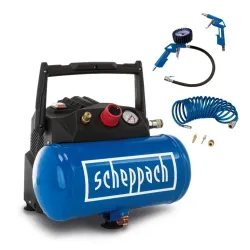
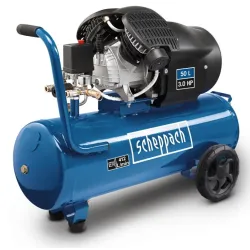
Tyres, blow-off, travel. Compact is enough: Airforce 7, AC10/8V, HC06.
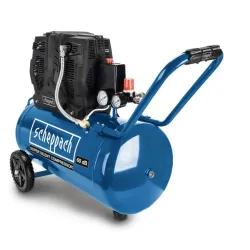
Mixed garage DIY. 24–50 L: HC30ox, HC25Si, HC51V, HC51Si. More: garage guide.
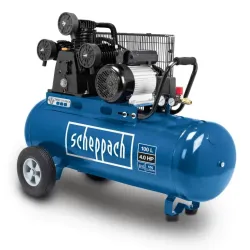
Higher-demand air tools. Read tool L/min on the card. Higher-flow class: HC53DC, HC550TC. Tools: air tools.
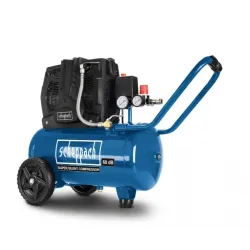
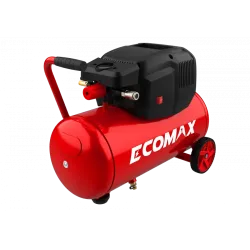
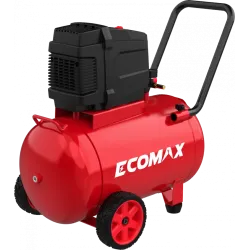
Noise-sensitive space. Silent is not a library, but ~60 dB(A) (Scheppach Si manufacturer data) is clearly calmer than typical ~90+ dB units. See silent and e.g. HC25Si / HC51Si or Ecomax Silent 6L.
Painting. Start from the gun, not the compressor ad. Honest limits: painting guide.
How to match a tool to a compressor
- Open the tool card: L/min and working pressure.
- Open the compressor card: look for delivery, not only intake.
- Add reserve — especially for longer work or hose/filter losses.
- If numbers do not match, change compressor or tool — not “more bar”.
Scheppach HC25Si / HC51Si manuals are a good example of honest positioning: Silent class fits a defined L/min zone and is not meant for very high-consumption tools (impact wrench, eccentric sander).
Common mistakes
- Choosing only by max bar.
- Confusing intake l/min with delivery.
- Buying 100 L “for the future” when the job is tyres.
- Expecting a small silent unit to run a heavy impact wrench continuously.
- Skipping condensate drain and basic filtration — moisture damages tools and paint finish.
A short path to buying
Parameters first: guide. Then, as needed: garage, tools, oil/oil-free, silent, painting. Range: Compressors. Brand with the widest HC/Silent line here: Scheppach.
FAQ
Is 8 bar “standard”?
Many DIY tools work around 6–8 bar. Sustaining flow matters more than hitting a number once.
Is oil-free always better?
No — different trade-offs. See oil vs oil-free.
Can a small compressor do “everything”?
For tyres and short jobs — often yes. For regular impact work or long spraying — usually no. Narrow the job honestly rather than buying a vague middle.
Reviews
Be the first to review this article.
Write a review