
How to choose a cordless drill for home jobs
A cordless drill is the tool you reach for most often in a home workshop: shelves, hinges, wall plugs, light drilling. That is also why people often buy the wrong one — too weak for concrete, too heavy for furniture screws, or a bare tool with no battery when they do not yet own a compatible pack.
This guide is practical. Examples from Scheppach cordless drills and, when you need more force, hammer drills. We do not quote prices here — they change. What matters is what is in the box, the figures on the model page, and whether the battery actually fits.
Volts, amp-hours and newton-metres are covered separately: what V, Ah and Nm mean.
Start with the job, not the “most powerful”
Before you chase Nm, answer honestly:
- What will you do most? Screws in wood and furniture, holes in metal, or light concrete and brick?
- Do you already have a Scheppach 20 V battery at home? And is it GEN2?
- Do you need impact mode? If yes — check the model, not only the word “drill”.
If 80% of your work is screws and plastic wall plugs, you do not automatically need a 150 Nm “armoured” profile. If you drill in concrete regularly, the opposite applies: a tool that is too light becomes frustrating fast.
Kit or bare tool?
This is where most first-purchase mistakes happen.
Bare tool means the machine without battery and charger. Kit includes both.
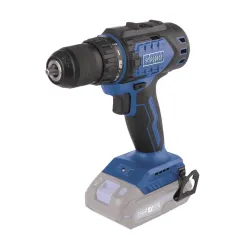
- BC-CD50SC-X bare tool — body only, no battery or charger; belt clip in the box.
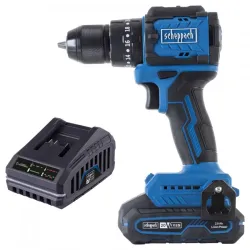
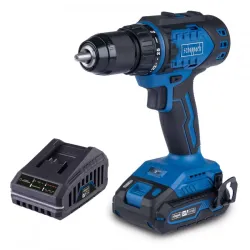
- BC-CD50SC-X SET S kit — same machine plus 20 V / 2.0 Ah battery and 2.4 A charger.
- BC-DD60-X bare tool — no battery or charger, for the GEN2 system.
- BC-DD60-X kit — with 2.0 Ah battery and 2.4 A charger.
If you already have a valid Scheppach GEN2 battery, a bare tool is logical and often cheaper. If this is your first machine on the platform — buy a kit. Otherwise you “buy a drill” you cannot use until you add battery and charger separately.
Important: GEN2 and GEN1 are not interchangeable. “20 V” on the label is not a compatibility guarantee.
What to compare on the product page — not in the ad
Another option in the same group: C-DTB74/1-X — kit with 74 accessories, 20 V 2.0 Ah battery and 2.4 A charger. Sometimes a “kit with bits” is a more practical start than an empty bare tool.
Torque (Nm). BC-CD50SC-X — up to 50 Nm; BC-DD60-X — up to 60 Nm; C-DTB74/1-X — up to 45 Nm. Higher Nm is not automatically “better” — match it to the screw and material. Too much torque in soft wood means torn fibres or stripped heads if you lack control.
Chuck. BC-CD50SC-X: 0.8–10 mm. BC-DD60-X and C-DTB74/1-X: 1.5–13 mm. A thicker bit simply will not fit a narrower chuck — that is physics, not preference.
Drilling diameters. BC-CD50SC-X: up to 25 mm in wood, 5 mm in metal, 6 mm in concrete. C-DTB74/1-X: 30 mm in wood, 13 mm in steel. BC-DD60-X does not list diameters in the description — then use Nm and chuck size, not guesswork.
Impact mode. BC-CD50SC-X can switch to hammer drilling. BC-DD60-X is drilling and driving without impact in the description. If you plan brick or light concrete, that difference is a decision, not a detail.
BC-CD50SC-X: two gears (up to 450 and 1700 rpm) and 20 + 1 + 1 torque steps. BC-DD60-X: 25 + 1 steps, speed up to 450 and 1600 min⁻¹. These are different machines, not “the same type in another box”.
When a hammer drill (or rotary hammer) is better
If concrete and higher torque are everyday work, look at hammer drills:
- BC-CD70SC-X kit — 20 V, up to 70 Nm; 30 mm wood, 10 mm metal, 8 mm concrete; kit includes 2.0 Ah and 2.4 A charger.
- BC-CD150-X kit — 20 V, up to 150 Nm; 75 mm wood, 13 mm metal and concrete; extra side handle and anti-kickback.
Heavy masonry also has rotary hammers — a different job from a screw in thin metal or wood. Do not buy “the biggest drill” if you actually need an SDS rotary hammer.
Battery: not every “20 V” fits
Scheppach GEN2 tools do not work with GEN1 batteries. The same applies to SBP2.0 and SBP4.0. Worx 20 V / 2.0 Ah is another system — the same voltage does not mean the pack fits a Scheppach machine.
Kits often include a 2.4 A charger. The separate SBC4.5A is 4.5 A (about 35 min for 2 Ah and 60 min for 4 Ah per manufacturer figures). Do not apply those times to a weaker kit charger. See also chargers.
2.0 Ah vs 4.0 Ah: usually longer runtime, not a “stronger” torque. Read torque on the tool’s Nm line.
Typical mistakes
- Buying a bare tool as your first machine on the platform “because it is cheaper”.
- Mixing GEN1 and GEN2 because both say 20 V.
- Choosing only by the highest Nm.
- Expecting a non-impact drill to “do concrete like a rotary hammer”.
- Forgetting protection — chips in the eyes move faster than regret.
Frequently asked questions
Is a bare tool the same machine as the kit?
Yes — the instrument itself is usually the same. The pack differs: bare tool has no battery or charger.
Does higher Nm mean it drills “everything”?
No. Nm is torque. Wood, metal and concrete diameters are separate lines — and not every line is filled in on every model.
Is one battery enough?
For a start — often yes. If you work longer, a second battery (e.g. SBP4.0) beats waiting at the charger.
Before you buy
Open the product page and check: kit or bare tool, GEN1/GEN2, chuck and Nm. For drilling, eye and hand protection help — see how to choose protective gear. If you also need a saw: how to choose a wood saw.
Reviews
Be the first to review this article.
Write a review