
How to store tools in a bag, case and box
Well-stored tools are dry, within reach and not mixed up. Poor storage means rust, lost sockets, a battery “somewhere”, and half an hour searching before a five-minute job.
Below — bags and cases, a belt and what not to confuse with car chemicals. For a home kit start: what to put in a workshop kit.
Bag, backpack and box — when to use which
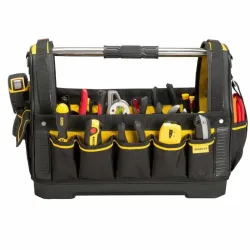
- Stanley bag with 12 pockets — pockets separate hand tools; handy when you carry “what you need today”.
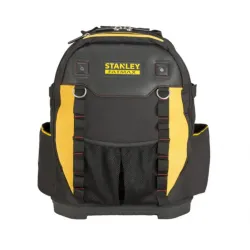
- Stanley Fatmax 28 L backpack — comfortable to carry with hands free; not “the whole workshop on your back”.
- Stanley Fatmax tool box — closed box; judge capacity by its dimensions, not backpack litres.
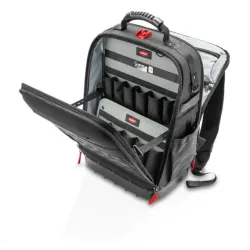
- Knipex Modular X18 — empty modular bag for order, not a filled tool set.
Stanley and Knipex solve different problems: one offers pockets, the other an empty organiser. Do not buy a “module system” if you only need space for hammers and screwdrivers — and vice versa.
In practice: if you carry tools often, bag or backpack. If they stay in the garage — box or case. If you work on site and grab tools often — a belt.
Belt for on-site work
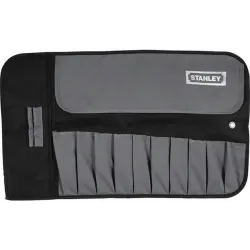
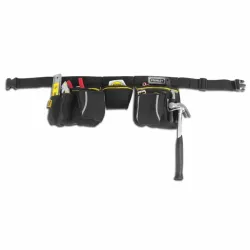
Stanley tool belt — hard-wearing fabric, pockets and hammer holder. Tools shown in photos are not included. A belt holds what you need in hand — it does not replace a case with 97 sockets.
If you climb ladders or work on a wall, a belt saves drops from pockets. At a bench, a case beside you is often enough.
Cases that already come with sets
KS Tools 97-piece and Scheppach TB235 already ship in their own cases. A second bag helps if you do not want to carry those cases every time. Do not store a bare cordless body (e.g. BC-CD50SC-X) mixed with an incompatible GEN1 pack — GEN2 ≠ GEN1. More: V, Ah and Nm.
Keep batteries in a dry place, not on a damp concrete floor “because it is convenient”. Give the charger air circulation as the description says.
Bench vice — for work, not a shelf
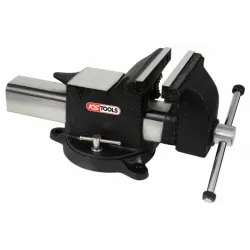
KS Tools 130 mm vice and 150 mm (vices) clamp the workpiece. They are not a storage system. Size is jaw width, not “workshop width”. If you want order, buy a bag or box; if you want to hold a board while you saw — a vice.
Oil and cleaner — not always for tools
Oils and greases are often for transmissions, differentials and industry. Valvoline Multipurpose 2 is for bearings and damp environments (ISO / DIN references) — not “spread on a drill chuck because it looks like grease”.
Motip Contact Cleaner is for oxidised electrical contacts (relays, sockets, auto/moto). It is not a universal tool washer. Many cleaners target car systems (brakes, engine).
If the tool page has no care step, car chemistry does not invent one. Store battery and charger only as their descriptions say. Otherwise “cleaning” becomes damage.
Simple order system
- Everyday tools — bag or belt within reach.
- Sets — in their own case, not dumped on the bench.
- Batteries — with the valid platform, not mixed.
- Chemistry — separate, by use, label facing up.
In short
Pick bag or box by how often you carry; belt for on-site work; keep kit cases for what already ships in a box. Read chemistry by application, not by category name. Order saves more time than “another tool” you cannot find.
Reviews
Be the first to review this article.
Write a review