
How to choose a saw blade: mm, teeth T and bore

A circular blade on the card is diameter mm × teeth T × bore. The first number must match the saw’s allowed diameter. Choosing a saw: wood saw. Circular vs jigsaw: comparison — these discs are not jigsaw blades.
| On the card | Meaning | Mistake |
|---|---|---|
| 160 / 165 / 190 / 216 / 250 mm | Outside diameter | A 165 mm blade in a 250 mm saw “because it fits” |
| 20T–60T | Tooth count | More T “always better on any wood” |
| 20/16 or 30/20/16 mm | Bore and reduction rings | “The bore will adapt” |
| Kerf 2.2 / 2.6 / 2.8 mm | Cut width on these cards | Mixing with 1.4 mm plate thickness |
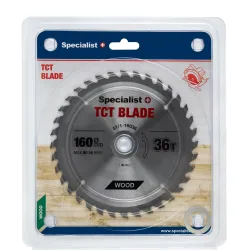
SPECIALIST+ 160 × 36T × 20/16 — 160 mm, 36 teeth, bores 20 and 16 mm, ring included, kerf 2.2 mm. 165 × 36T × 20/16 — 165 mm, same 36T. 160 mm is not 165 mm.
165 × 24T × 20/16 — 24 teeth. 165 × 30T × 20/16 — 30 teeth. 24T, 30T and 36T on 165 mm are three blades.
190 × 20T × 30/20/16 — 20 teeth. 190 × 56T × 30/20/16 — 56 teeth, same 190 mm. 20T vs 56T is coarser vs finer in this row — pick T for the job, not the dearest disc.
216 × 48T × 30/20/16 — 216 mm, 48T, kerf 2.6 mm, plate 1.6 mm. 250 × 60T × 30/20 — 250 mm, 60T, kerf 2.8 mm, plate 1.8 mm, ring included. A 250 mm blade is not for a 165 mm saw. Saw blades. Holesaws are another category.
Sources: mm, T, bore and kerf from the cited cards (19.10.2026.).






Reviews
Be the first to review this article.
Write a review